Monday, June 27, 2011

Summertime Sensibility, Spreads and Strawberries

School's out!  In all honesty, I was feeling a little bit adrift last Friday, particularly when I turned in my school keys.  I will truly miss my team members and the rest of the middle school faculty.  The group of people I worked with were sensible and grounded.  There was none of the drama that is associated with many workplaces.  We worked well together and were a functional, well-oiled unit.  Our different personalities complemented each other fabulously, and it is a shame that the middle school is no longer in existence. 

With it being a somewhat emotional day, I came home and realized I had locked myself out of the house.  Note to self:  don't give the key to the house sitter a week before you actually leave town, you just never know when you need that hide-a-key.  So there I was, without a spare, at 5:30 in the evening, in a very short summer dress (I had just come from the retirement luncheon).  I did have a cell phone (surprisingly), and I called a couple people, hoping I had given at least someone a key in the past.  No luck.  But, a dear friend came over and helped me break in (not easy) without doing any permanent damage.   We then shared a couple beers watching the sun set over the hills.  So, be sensible, and make sure your neighbors have a copy of your house key!

In the garden, the garlic scapes are up.  I never really know what to do with scapes, but it would be very insensible to not use them in some way, shape or form.  It is possible to grill or saute them.  I also learned last year that you can make garlic pesto out of them as well.  I don't really follow recipes when making pesto-I just do a lot of tasting to figure out if the proportions are right.  So, basically, you would use garlic scapes (with the flower part cut off) instead of basil, and walnuts instead of pine nuts (walnuts are cheaper).  Throw some Parmesan cheese in there and of course olive oil and blend.  I freeze the pesto in ice cube trays then put in a plastic baggie in the freezer.  When you want a great snack spread, mix the pesto with the same amount of cream cheese.  Yum!

Another recipe which I made for my team party last week is as follows:

Spicy Chesapeake Chicken Spread
 2 packages (8 oz) softened cream cheese
1 TBS bottled steak sauce (I used BBQ sauce as that was what I had around)
1/4 tsp curry powder
red and black pepper to taste
1 1/2 cups minced cooked chicken (I also threw some turkey in there as I had it around)
1/3 cup minced celery
1/4 cup chopped parsley
1/4 cup chopped toasted almonds
crackers

1. Beat together cream cheese, steak sauce, curry powder and pepper.
2. Blend in cooked chicken and celery and 2 TBS parsley.  Refrigerate remaining parsley (or just don't pick it until later).
3. Shape mixture into log.  Wrap in plastic and chill for 4 hours or overnight.
4. Toss together remaining parsley and almonds and coat log with this mixture.
5. Serve with crackers (duh).

You may want to half the recipe as my darling husband and I were eating chicken spread sandwiches for three days, and that was after the people at the party had it!

Finally, let's be sensible about strawberries.  We love fresh strawberries and we use them throughout the year in smoothies, on french toast and waffles, or in sauces, spreads and dressings. I also make lots of strawberry preserves when I can find the time.  However, the season for finding relatively cheap strawberries is relatively short and I don't have time to make jam.  But I do buy them in bulk at the farmers market (I can buy a flat of 8 quarts for $30), rinse them, remove the tops, spread on cookie sheets and freeze.  When frozen, put in plastic baggies or containers.  Out of sight, out of mind (for the moment).

Enjoy the first "real" week of summer!

Friday, June 10, 2011

Infertility in a fertile land

My darling husband and I celebrate our fifth anniversary today.  We have shared so much on our relatively short journey and I feel truly blessed that we are together.  We have each other, Bud, our families and friends, and our farm. 

It is also really the fifth year anniversary of us being unable to have children.  This part of our life together has run the gamut of emotions and it seems to have finally come full circle.  For the first year, we weren't too concerned about our inability to conceive, but the medical community defines infertility as a couple unable to conceive after a year.   I had great reservations about crossing into fertility procedures (for all those in similar situations, you know--the constant blood work and ultrasounds, the shots of hormones, the invasiveness of it all, the not knowing, all of the moral and ethical questions that arise).    I remember talking with some close friends about my hesitancy of pursuing treatment and my main argument was that the process really interferes with the normal processes of the body.  However, I also knew that the in-vitro is really quite successful, and so my husband I decided to pursue the option. 

In the beginning of 2009, we went through 6 months of less invasive treatments before we had to take a break due to feeling so overwhelmed with the process.  We then went back for another 4 months of more aggressive (in-vitro) options in 2010. We were not able to complete either in-vitro cycle and I was declared to be a "rare case" by the doctor.  I was left in a state of great physical pain for about a week, and emotional pain for considerably longer.  Several people suggested we get a second opinion, but after much thoughtful consideration we decided that my body was sending clear messages to me that this route was not the road to be taken at this time.
For me, going through the process of advanced fertility treatments made me feel a lot worse about myself as a person, and really did a number on my perception of my own womanhood.  Here I was, unable to bear children, the very core of being a woman, and every other day, when I walked into that center (which was an hour and a half away)  I was reminded of this flaw.  And every time when the fertility docs came up with a new plan that didn't work, I felt like it was somehow my fault.

I tried to rationalize everything, thinking that my inability to have kids was in the grand plan.  Perhaps that's one reason why I fell in love with a man who already had a son, a son who is with us more often than not and who proudly proclaimed, at the age of two, "I have a mom, a dad and a Distan" (me) as if everybody in the world has a Distan.  And I guess to some degree I continue using this paradigm.  Maybe this is why I have the interest in midwifery, or why I teach children.  I am able to play a large part in children's lives, without having one of my own. 

Many couples in our position, and particularly women, have a difficult time when their friends, colleagues and acquaintances become pregnant.  I remember standing at the photocopier and someone announced, "Watch out, the last three women who stood there ended up pregnant within two weeks."  Not helpful.  There is no correlation between making photocopies and pregnancy thank you.   Then my general practitioner said "Just wait.  It will happen when you least expect it."  Righto.  For some of us, it won't.  End of story.  Thank you.   She's not my general practitioner anymore (although I can't say it's because of that comment--she moved on to gerontology).  My darling husband also mentioned how difficult it was for him to preach a Christmas Eve sermon because it was so focused on birth.

I sought alternative practices and readings, namely acupuncture and energy healing.  While apparently I still can't conceive children, I was able to realign myself and am now in a much better place than I was a year ago. 

Interestingly, I somehow got on the mailing lists for all sorts of baby products and literature in the mail(probably thanks to the fertility/pharmaceutical corporate machine which thinks I ought to have a baby by now).  Fortunately, the local food bank is always in great need of baby formula.
 
It's really hard to talk to others about infertility and I'm sure many of you who are on this journey feel similarly.  My closest friends know, and some of my family, but I had to wait a while to feel more removed from the process to just say, "You know, I can't have kids."  It's also really hard to write about, but this is a cathartic exercise.  I remember when I was going through the process I dreaded looking at infertility websites on the Internet.  Everybody had a different opinion on the topic, a different experience.  By and large, I ignored the Internet, in an effort to stay somewhat sane throughout the process.  I found the hundreds of pieces of tidbits offered by folks confused me even more, made me feel more unsure about whether I was taking the "correct" course of action. My life was suddenly becoming emotionally very complicated and I was losing touch with who I was.  
I can empathize with all couples going through this process, but it is such a personal journey, and there is no one way to feel or act or react.  There is no "right way" to go about it.  Follow your own heart.  Do whatever it is that feels right for you and your partner.

Monday, May 30, 2011

Wild Windy Weather

The long Memorial Day weekend has had an ominous start as some very unstable weather has made its way to our area Thursday night.  We were all just getting ready to go to bed when the storm hit us.  The lightning display was spectacular but the heavy winds were quite damaging.  The power went out, causing Bud to wake up, and the boys ended up sleeping on futon mattresses downstairs where they could be calmed by the weather radio and be cooled by the lower downstairs temperatures.  Fire whistles were going off for much of the night and emergency crews were out clearing roads from downed power lines and trees as soon as the winds died down.  We woke up to find that the top 20 feet of one of our tall pines had snapped and been flipped around as it fell to the ground.  Fortunately, most of the downed trees seemed to fall ten feet away from the homes and not directly on them. 


We were surprised to see the fallen part of the tree oriented this way--it had to either have flipped in mid air or been pushed by the wind as it came off.  


Friday was beautiful and my darling husband and I spent most of the afternoon in the garden.  I planted some beets, greens and cucumbers and dug the bean bed.  Unfortunately, last night around 8pm, another set of thunderstorms came through with heavy rain, and I'm sure that most of the seeds got washed away.  We will simply have to assess and maybe replant later in the week.

While digging the bean bed, I came across some old potatoes that were still in the ground so I dug them up.  I also picked some of last year's fall lettuce that had been insulated by the snow and then started regrowing this spring.  The lettuce was delicious in our first green salad of the year.  The potatoes were more of a disappointment, but considering they were salvaged, we didn't have high expectations.  The new potatoes in the neighboring plot will be ready in a couple months. 

Sunday, May 22, 2011

The Final Count(down)

When starting this post I realized that the "final count(down)" could mean one of several things:  the end of the world as we know it if you're from Harold Camping's camp, the end of the Space Shuttle era if you're a NASA junkie, or the end of the school year if you're a student (or teacher).

Last night, my darling husband and I did a final count of the animals we have on the farm.  With the arrival of four Berkshire/Duroc piglets yesterday, we are in full operational mode for the next six months (well, minus some broilers we'll be dispatching).  The final count:

26 Cornish cross broilers
10 hens (and 1 rooster)
10 Dorset cross sheep
9 turkeys
4 piglets
3 cats
2 dogs
1 horse

Total count:  66 animals, of which 43 will only be here until October (sorry to be so morbid, but that's the reality of it). 

Our trip down to the Southern Tier of New York in a borrowed 1980-something vintage Dodge pick up to retrieve the piglets was relatively uneventful.  We found some old karaoke tapes (one of our friends holds regular karoke evenings in the church basement) in the cab of the truck, and shamelessly played them...with the windows down.  After all, it wasn't our voices on the tapes.  Bud got a kick out of listening to "Sweet Caroline" and a very off-key "Achy-Breaky Heart".  There's only so much one can do to keep a 9 year old entertained on a four hour journey.

We took the truck out again today to help a dear friend move some belongings.  Three trips to the storage unit was all that was required and we just barely dodged the requisite afternoon rainstorm (which was a good thing considering the last load had boxes of cameras and canvases in it).  Bud was very proud of the fact that he snagged a 1980-something era mortar board, a very cheesy pair of sunglasses and a garden owl (thanks Doug!).

And since it's not often that we have the use of a pick-up truck, my darling husband will be taking our snowblower in for a tune up--better do it now as it will be snowing before you know it (or at least before we would normally have the snowblower in working order) as well as the weed-whacker (which we definitely do need as the grass is enjoying all of the rain we've been getting).

I could probably think of a hundred more uses for the truck before we have to return it tomorrow afternoon, but I'm tired and tomorrow I will be camping overnight with my students, so sleep is definitely a requirement!

Thursday, May 5, 2011

Catching Up

I can't believe that it has been over a month since my last post.  Obviously, things have been a bit busy on the farm. The poor weather conditions have not helped much.  It was the second wettest April on record in our area, which prevented us from doing much of anything outside (fencing and planting). 

First, kudos to our friend Doug who was watching the farm while we went to visit my darling husband's family.  One of our ewes gave birth while he was on call and he went above and beyond to try and save one of the two lambs.  When all was said and done, each of the new moms gave birth to twins but only had one survive.  We have four rambuctious gamboling lambs now.  Two of them are as of yet unspoken for and will be ready for processing in October (if there are any takers out there in Cyberland).

We also constructed (largely in the rain) the chicken tractor for our broilers.  The plans we followed can be found on this website.  While perusing plans for chicken tractors I was surprised at how many plans included pressure treated wood!  The plan we used actually calls for EMT (electrical metallic tubing) which is both light and sturdy.  Our final product looks pretty much the same as the one on the website, and it seems to be keeping the birds in and predators out.  However, it was somewhat frustrating to construct (did  I mention it was raining the whole time?!) as the structure wasn't entirely stable until the hardware cloth was attached.  All the birds are now out of the shed (see this post about shed usage), which is a good thing, as it was getting to smell rather ripe in there!

Sheep shearing is behind schedule as well.  Usually, we have sheared the sheep and sent them up to the pasture by now. But with the late birth and the wet weather shearing isn't scheduled to happen until mid May (just days before we get our piglets). 

The good news is that the horse did get shod, so he is ready to go (once it dries out) and there is plenty of lush green pasture for everybody. We also have asparagus coming up!  And I also managed to sew the curtains for the kitchen window (five years after moving into the house).

Next on the never ending list:  plant the peas, carrots, onions and potatoes (and actually write down the garden plan), assemble the 1979 Ashford spinning wheel I was able to find over April break and enjoy the few moments that the sun actually shines!

Wednesday, April 6, 2011

Lamb Tales

It's lambing season again, which translates into a fine line between letting Mother Nature take her course and interfering when necessary. Before we go on, let's meet the flock.


Tess is the middle black mama with the horns (white stripe on her face).  Rachel, her mother,  is to her left (our right) (grey with white stripe).  Our dearest friends owned the ewes before we did and this picture was taken at their famr on our wedding day (durng the reception).  We inherited Rachel, Tess and Uma (who passed away last year after a difficult birth).  


Our first year of breeding Tess delivered healthy twin ewe lambs.  Above is Tess's daughter, Velveeta (09), who is now due any day with her own lambs.  Uma delivered a singleton ram lamb (shown below on the left) and Rachel delivered a singleton ewe lamb, Velma (below on the right).


Velma just gave birth on Monday to two ram lambs.  One is thriving, but the other died on day 4.

Tess's 2010 lambs; also two ewes, Wanda and Wilma, both of which will be bred next year. This photo was snapped when they were just minutes old.  Wanda (black) isn't even up on her feet yet.  These yearling ewes now act like typical teenagers and are really quite obnoxious.  However, Tess has been an extraordinary mother (Uber-mom) and has delivered healthy twin ewe lambs consistenly for the last 5 years.  Her lambs this year will be her last and she will go out to pasture with Grandma Rachel.

After our first successful year of breeding the ewes, 2010 brought along some significant difficulties.  Uma needed much assistance delivering two very large lambs (and she was early).  We had the vet, her former owner and a plastic surgeon (I know, I know, but he was the husband of the vet) all present, but she eventually succumbed.  We tried to bottle feed the lambs, but both ended up dying in the first three days.

Luckily, Tess pulled through a week later with Wanda and Wilma, without any difficulty.  While we had thought that Rachel was bred as well, she ended up not having lambs.  At the time we weren't sure how old she was, but it turns out she was 9 at the time, probably well past her fertile years.

After last year's issues, my darling husband and I ordered all sorts of lambing supplies through Premier so that we were sure to be ready in the event of any emergency.  The earliest possible due date was Saturday March 26th and my parents were actually watching Bud and the farm while my darling husband and I were both on business trips.   They were a bit concerned about how to handle a pending birth, but we assured them Mother Nature usually took care of it.  All they had to do was set up the jug, towel off the babies, bring mom a warm bucket of water with molasses, snip the umbilical cords,...and..and..and..

Luckily, the lambs weren't born until 12 hours after my parents had left.  I had decided to take the day off from school as Velma looked like she might be sick and I had a vet call planned.  It turns out Velma was just in labor!  The lambs looked pretty good from the start, but by Wednesday morning, we found the little one was suffering from hypothermia (he probably wasn't getting enough to eat).  We brought him inside and tubed him (thank goodness for YouTube videos) so that he would get the required nutrition.  Tubing is a daunting experience for someone who has never put a stomach tube in before, but it was actually quite simple and painless for the lamb.  We kept the lamb in the bathroom for the day with a heat lamp on him and by midafternoon he was jumping around.  Thinking all was okay, we reintroduced him to mom.  He seemed fine, but was having trouble nursing.  I bottle fed him every four hours, but he suddenly died sometime between 6 and 9am on Wednesday.  The other lamb seems to be thriving.

Now, we are waiting for Tess and Velveeta.  Hopefully, all will go smoothly.   Through conversations with many shepards both in person and on Homesteading Today, it seems that Mother Nature will go ahead and do what she may, and perhaps that is for the better.  Often times, a lamb is not meant to survive, and interfering may only prolong the pain and suffering.  Taking Velma as an example, it may be that as a first time mom she was not producing enough milk.  She also may have had some
"issues" coping with twins her first time around.  Now, she is able to devote all of his time to her one lamb, and is doing a fine job of it. 

When Death finds its way to a farm, it is often difficult to not blame oneself or to think "What could I have done differently to prevent this?" It often makes me feel as if I'm doing an inadequate job.  But we have to remember that Birth, Life and Death, are much more powerful than a single farmer is.  All are part of the Great Circle of Life, and all need to be respected, even admired.

Sunday, March 20, 2011

Why we haven't built our family room yet


When my darling husband and I first bought the farm, we had grand plans of turning the "shed" that is attached to the kitchen into a family room.  Many evenings were spent discussing how we would reorient the woodstove, where the mudroom would be, would it have a cathedral ceiling (and thus lose the attic space above it), would we open it up to the kitchen, etc.  We believed that this additional family room would be necessary, as we would have several children and our current set up does not provide an ample indoor space for older kids to "hang out".

The "shed" is on the far right in this picture, from the hot water pipe onwards. Conveniently, there are two exits directly to the outside from the shed. 
                                                                               
Now that we've lived in the house through five winters and summers, it has become clear to us that the benefits of the shed outweigh the benefits of a finished family room.  The shed is a space for all seasons, and without a garage, one of its main functions is as a storage unit and recycling containment center. It also is where the workbench and all the tools call home. 

While storage is certainly a noble purpose for a 400 sq. ft. space,  it was the seasonal activities that occur in the shed that led us to believe we would not be able to part with it.

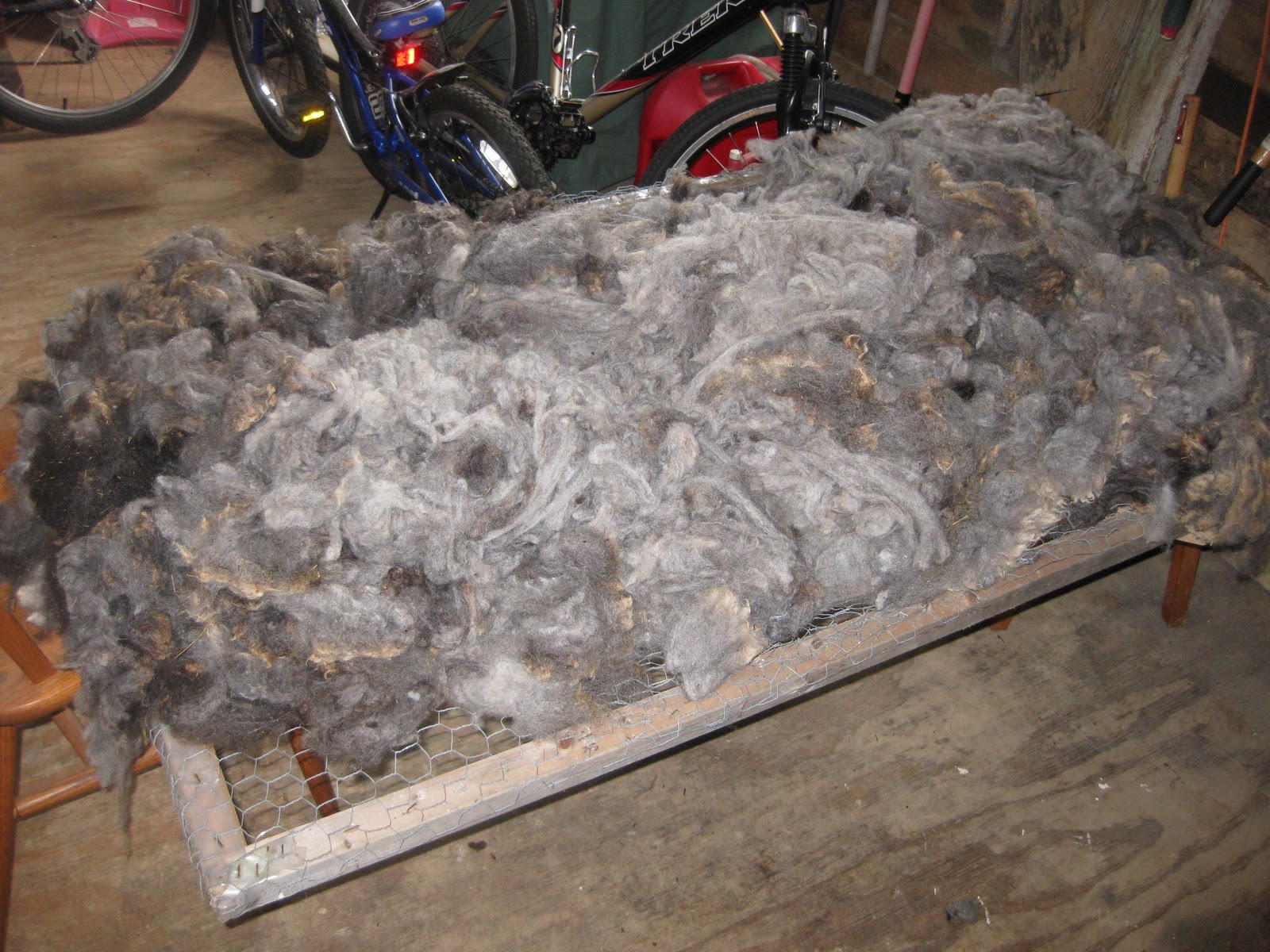
Early Summer:  I use this area to clean the shorn sheep fleeces before sending them out to be carded.  It's a tedious process, particularly since the sheep live with burdock, but I usually get most of the crud off. 

Tess and Rachel's wool on the screen, ready for picking
Late Summer:  Harvesting.  Need I say more?  We set up the saw horses with a screen to lay the onions, garlic and beans out to dry before storage. 

Fall:  We continue with harvesting, but the main purpose of the shed is for apple pressing.  Bud and his father spend evenings out there grinding up apples and then pressing them into fresh cider.  While we end up hardening most of the cider, we also freeze 3-4 gallons each year.

Bud shows off his cider pressing abilities.  In the background of this picture, you can see the sawhorses and screen with beans drying on it!

Winter:  You would think that winters are relatively quiet on the farm, and indeed they are.  However, the picnic table, lawn furniture, fencing and fence chargers, and wood all come in for the winter.  While our barn could hold much of this material in the summer months, the barns in winter are stuffed to the gills with hay (and more fencing equipment). The shed, since it's not heated, is also a fabulous refridgerator in the wintertime.  Pots of stock, soup, left over hams, freshly butchered poultry, pies, puddings, and beer have all been stored out there to great satisfaction. 

Early spring:  This is probably the busiest time for the shed.  I use the floor space in April to cut and dry seed potatoes.  It is also where we raise our chicks and turkey poults for the first 4 (if you're a chick) to 8 (if you're a turkey) weeks.  This year, we actually received our shipments of both types of fowl at the same time, and quickly had to build another brooder for the chickens.  With powerful heat lamps, they seem content, even though night time temperatures are dipping into the teens. 
Turkey poults are in the front box; chicks are in the rear. 
Our chicks from a few years ago.  We actually ended up putting them in our broken shower upstairs when it got too cold for them in the shed (we didn't have heat lamps at that point).


As you see, it would be rather difficult to find a replacement home for all of these activities.  Thus, it appears the shed will stay a shed, as the concept of a family room doesn't seem so necessary anymore.  

Sunday, March 13, 2011

A Prairie Home Companion

I wanted to start this post with It's been a quiet week in...my hometown" but I'm afraid Garrison Keillor claims ownership to that line.

My darling husband and I met just over 8 years ago, and I think back on these years with a certain nostalgia.  This was a time before we had a farm, a time when we gardened on a plot of our dear friends' farm, a time when my stepson, Bud, was still in diapers.  I was traveling through the Berkshires and across the Hudson to visit, still holding down a teaching job in Massachusetts. It was a time when I pondering my next step in life, not wanting to be apart from my soon to be husband.  I applied to a graduate program not far away from where we would eventually settle in a field that would prove to be exciting, but not very applicable to the job market in upstate New York.

During the colder months of these two years, my darling eventual-husband and I would often spend our Saturday evenings in quiet companionship, listening to Prairie Home Companion, a mutual secret love.  I grew up listening to NPR, and my family collected the Lake Wobegon recordings on cassette.  I think there are a lot of us Lake Wobegon wannabes even among the young adult crowd, and it turns out that most of my close friends have been regular listeners at one point or another in their lives. 

Visiting with a dear friend this afternoon I was reminded that my own life here in Upstate is in fact a bit like those who inhabit Lake Wobegon.  While we are well-informed of world events, the inhabitants of the village are very active in local community affairs.  We have three public buildings in our small hamlet of 1000 folks: the church, the grange, and the town hall.  All three buildings have a variety of activities going on, from meetings, lectures and workshops to quilting groups, dinners, dancing and variety shows (in fact, we have a variety show troupe that stages a show every year at the church and was actually a finalist on Prairie Home Companion's "Talent from Towns Under Two Thousand" about twelve years ago).  Much of the region is made up of similar villages, and it is quite possible to sustain oneself solely on covered dish suppers, spaghetti dinners and pancake breakfasts that are offered by each community's gathering center. 

All of these public gatherings provide grand means for propagating gossip.  Sometimes, it seems a bit like the old parlor game, telephone.  "He said, she said", "I heard, you heard..." and can get quite tiresome.  Sometimes, I forget how efficiently the rumor mill gets started.  Just last week, a neighbor (and pediatrician) approached my darling husband saying "I hear your wife is changing careers!".  Aside from this blog (which I know very few people actually read, and most of them are FB friends) I had told a grand total of five people about my career path.  Perhaps the small town living keeps us all honest to a degree and it's a good reminder to me to probably tell my boss of my plans before he hears it from another source first.

Sadly, moving to the farm, we have lost some connection to Prairie Home Companion and the News from Lake Wobegon.  The evenings often run late by the time dinner is cleaned up, animals are fed and baths are taken.  And, with all the hustle and bustle of the day, the three of us will often just collapse on the couch for a half hour before bed, wrap the flannel blanket around us, and read, enjoying each other's company in silence.     

Tuesday, March 1, 2011

You Better Belize It

Four days ago I was snorkeling with sharks off the coast of Ambergris Caye.  A week ago and I was admiring the ancient Mayan city of Tikal.  Now, I'm back in two feet of snow.  

Our vacation was filled with much fun and celebration, and probably a few too many rum punches. If anything can be described as bright and beautiful, Belize is it.  The colors and warmth of Belize contrast sharply with the cold dreariness that continues to envelope us in the Northeast.

Belize is a small country, roughly the size of Massachusetts in area with only 350,000 residents.  We were able to enjoy spending time in two very different ecosystems, the pine forests and the beach.  Tropical rainforests, dry tropical forest, and lowland savannahs are also part of Belize's ecology.  The people of Belize vary just as much as the landscape.  There are sizeable Creole (distinct from the French Creole that we know of here) and Mayan populations, along with a large Mestizo population.  People were proud of their ancestry and described in great detail their ethnic heritage.  The official language is English, thanks to British imperialism (Belize only became fully independent in 1981) and we discovered that some locals don't consider Belize to be part of Central America because Spanish is not the primary language. 

Belizeans seem to live simple yet fulfilling lives.  Many of their homes seem to be built by their own hands; simple structures built on stilts, containing one or two rooms for a half dozen people.  Cooking and much of the daily activity can occur outside thanks to the warm, sunny weather.  People got to work by bus, carpooling, horseback, walking or riding a bicycle. 

The wealth of knowledge of all the Belizeans we met astonished me.  While school is mandatory until age 16 (like it is in the States), every Belizean I spoke with regaled us with information about the Mayan ruins, the seasonal and annual weather patterns, the political history of the country, the natural history of the area.  It was like speaking with a cultural anthropologist, historian, sociologist, archaeologist, ecologist, marine biologist, speleologist and meteorologist all at once.  Because Belizeans don't hold material goods in such high regard, and because their survival is more tightly connected with the land and interpersonal relationships, learning about their environment and their own history is a necessary part of their lives.  As mentioned elsewhere in this blog, such knowledge is lost upon us as middle-class, materialistic, Americans.  We depend on the nuclear family, not the community to help us in times of need or to share in our joys.  We look to specialists to give us the information, and thus we don't take the time to learn it ourselves.  We think that the more stuff we have, the better off we are, paying little regard to the relationships we form with each other and with our land. Ultimately, what does this mean for us as a people, and a culture?   We may be rich in "stuff", but in the long run, how far is that going to get us?   

Saturday, February 12, 2011

It all falls apart, and a moment of clarity

On Wednesday, our oven range called it quits. According to my darling husband, this happened in rather dramatic fashion as he was trying to warm up a burrito for lunch. 

There are several ways in which I could have reacted to this event, the natural reaction being one of frustration as the water heater just had to be replaced 10 days ago.  But, another convergence of events has taken place and I have learned that it does no good to get stressed out about such mundane things like water heaters and ovens.  We are really doing okay.  We are put on this Earth for a tiny blip in time and need not concern ourselves too much with such minor annoyances.  We simply had to get creative in the kitchen, using our wood stove to cook ham and eggs, and to bring out the electric griddle for pancakes (breakfast for dinner is the best!). We may have the new oven hooked up by Monday.

Where is this new calmness coming from?  I think I can largely thank some acupuncture treatments for this current moment of clarity, as well as some significant changes that have occurred at work.  One of our team member's lost her job due to budget cuts, and the entire school faces some major restructuring.  I think that sudden slap in the face provided me with the impetus to reevaluate and figure out how to pursue a dream I've had for the past ten years, which is to become a midwife.  I enjoy teaching, but I'm not passionate about it.  When I first considered midwifery I was in my third year of college, and the idea of five more years of school was too daunting (it would have been easier if I had decided to go into nursing right after high school, but hindsight is 20-20).  I will still have to go to school for at least three years full time to take the most accepted education route to become a midwife.  But, with my darling husband's blessing, the process doesn't seem as daunting as it did 10 years ago, even if it requires me to move to the City for a year (yikes!). 

I think we all have a Truth inside us that sometimes we ignore, or sometimes we fight against.  Some find that Truth more easily than others.  My path thus far has certainly been long and winding, but I suppose it's all part of the journey of life.

Monday, February 7, 2011

Yarn...in the middle of nowhere

This past Friday night, my darling husband and I took a drive down Route 20 (this is the same Route 20 that goes from Boston, MA to Newport, Oregon) to arrive in a small town just east of Cazenovia, known as Nelson.  Allegedly, there was a small (tiny?) music hall in this small (tiny?) hamlet that was bringing in some rather significant Americana acts.  Yarn was playing on Friday, an alternative country/Americana band out of Brooklyn that we had heard once before in Saratoga Springs.

The problem with going on a date in the middle of nowhere is that there are very few dining establishments around.  When our first attempt failed (the restaurant was apparently closed for the winter) we ended up in Cazenovia, a small college town.  One would think a few dining establishments catering to locavores, would exist, but we couldn't find them.  However, we did find the quintessential upstate New York steakhouse that was hopping. This was a no-frills establishment which reminded me of a basement rec room growing up complete with the industrial carpet and the cheap vinyl seats.  The food was very respectable as was the beer.  We learned from our server that the place had been owned by the same person for 50 years and it was closing its doors on Sunday for good (hence the crowds).

Back to Yarn.  As we were trying to find our way along the highway, looking for roadsigns peeking up above the snow, I was reminded of another musical haunt in the Berkshires, The Dream Away Lodge.  Also in the middle of nowhere, this establisment was at least made famous by the likes of Guthrie and Dylan.   The Nelson Odeon is not an old farmhouse (nor a former brothel) like the Dream Away, but a converted grange building.   The property was bought and renovated by a couple who apparently had a vision of bringing musical performances to the fine folks of Nelson.   Whatever marketing they have done seems to have worked as the place was filled  to capacity  (was all of Nelson there?).  What was advertised as two 45 minute sets ended up as four hours of country rock including some fabulous electric mandolin jams (who knew?).  If you can, check out the track, Abilene, by far my favorite.  Before long, this motley crew of Upstaters was dancing in the aisle, beer in hand, singing (relatively on-key) with the band.  Homemade desserts and freshly roasted coffee were sold at the break, and while waiting to use the one bathroom available (although the guys thought the row of pine trees made fine stalls even in subzero weather), we were able to mingle with the owners of the establisment as well as with some of the bandmembers.

We made it home shortly before 1am to two dogs and a couple cats who were a bit confused as to why we were out so late.  The evening was another reminder to me of the hidden cultural gems that lie in our midst for those who wish to seek them out. 

Sunday, January 30, 2011

Turning a Heel and other Fiber Experiences

I'm in the middle of knitting my first pair of socks ever.  What makes it doubly challenging/frustrating/rewarding is that I am making it from yarn that I hand spun (not with a wheel) with wool from our sheep (although I didn't shear the sheep myself).  The progress thus far:

I turned the heel last night, which as any knitter knows, is probably one of the most feared of all knitting techniques.  This is why, after 15 years of knitting, I have not yet knit a pair of socks...until now.   With the advent of YouTube, where one can actually watch a video of someone turning a heel (and rewatch over and over again), it becomes a little bit easier.  I am not working from a pattern for these socks as I couldn't easily determine the weight of the wool, and it's not really consistent in size either.  So I'm using a general guideline that I found here and I'm supplementing with other information I find on the web.  It's also taking a considerable amount of problem solving and looking at how socks are actually put together (yes,my darling husband, I really am being productive when I stare down at the woolies on my feet for five minutes at a time). 

In other news, I am working on my hand-spinning technique and can actually create yarns with different weights.  I also went to my first spinners meeting this past week.  This is not the bicycle, exercise kind of spinning, although that would also be a good use of my time, but the old-fashioned wool spinning.  About 20 women of all ages and background came together with their wheels and shared what they had made in the course of the past month.  Some of the creations were truly fantastic including felted hats and cabled throws.  I brought my broken-down $40 garage sale salvaged wheel which looked pretty funny compared to all of the newer wheels.  Below is a picture of my wheel. 
This is basically considered a "clunker" now, as the newer models looks something like this.  Oh well.   The woman who runs the spinning group took a look at the wheel and determined that it may actually have been made for decorative purposes only as the tensioner at the left end isn't actually functional.  Now, who would go through all the trouble to reproduce a wheel with all the working parts except one?  She offered to take it home and try to fix it, and for that I am grateful.  So I continue to hand-spin and knit away, and the snowflakes continue to fall.

We haven't been hit nearly as hard as the folks on the East Coast.  But we are all preparing for another storm (or two) this upcoming week.  Along that vein, my darling husband, Bud and I have moved all of our wood inside and had the oil company fill our backup oil tank.  We also have taken stock of our freezer. We have no shortage of meat, but the green vegetables from the summer garden are dwindling quickly.  We may have 5 quarts of green beans left, and a smattering of corn, carrots and peas.  Bud ate the last of the apple sauce last night.  As usual, we have a plethora of potatoes and there is still some winter squash, although it's certainly not in prime condition.  If we get desperate, we could try the beets I froze two years ago, or the frozen kale.  We also have several quarts of homemade chili that my darling husband made a couple weeks ago.  100 days until the asparagus comes up, and possibly sooner for the lettuce (depending on if I get the coldframe up in time). 

Stay warm this week!

Monday, January 17, 2011

If you let them, they will play

Due to the long weekend, and the abundance of snow, we decided to host a sledding party for some of our friends.  The instructions were simple...bring your kids, your sleds and dress warmly.  While the temperature hovered around 15 degrees, the sun was shining brightly and there was no wind.  I wish I took pictures as the colors of the sleds and the parkas against the white snow and blue sky were striking.  After two hours of play in the snow, 7 kids, 7 adults and one Labrador retriever tromped inside for some hot chocolate and popcorn as the sun began to set over the western hill.

I am not a fan of the cold, but I find the combination of good friends and sunshine helps to bring me out of my shell.  More importantly, I find that given a wide open space and very little parental involvement, kids will play appropriately and learn valuable social skills, as well as hone their imaginations (oh, and have a good time).  In an era where everything has become so directed, imaginative play has become a lost art.  Kids are continually connected to a screen of some sort or another, or participating in structured lessons, sports or other activities where someone (or something) is telling them what to do and how to do it. Structure certainly has an important part in a kid's life, but not to the extent where there is no free time at all.  It is a good thing for a child to be "bored" as it forces him or her to figure out what to do with that time.  We find in our household that Bud will often want to "do" something with one of us. But if we're both busy, we send him off on his own.  Usually he ends up deciding to read his novel (currently, the Nicholas Flamel series) or coming up with some sort of game in his room to play with his guys (the Fisher Price castle  and figures Santa brought him when he was 3 and other assorted cars, trucks and blocks that he has accumulated over his short 8 years of life).  Wendy Mogel discusses children and boredom in her book, The Blessing of A Skinned Knee: Using Jewish Teachings to Raise Self-Reliant Children. 

One of the party-goers who also homesteads mentioned that her family often has a fossil-fuel free day, which requires the children to think creatively about how to spend their time without going into town.  If we as parents hunker down and don't cave in to the constant bombarding of "Can I play on the computer?, Can I watch a video?" etc., the kids will retreat and start some activity or other on their own.  If we let them, they will play.  Albert Einstein once said, "imagination is more important than knowledge".   One of my colleagues who teaches sixth grade actually has this quotation painted above her windows in her classroom.  Many may question this idea, but without imagination, there is no pursuit of knowledge.  If kids are trained to just google the answers to any questions they have, or ask a teacher or parent who will just give them the answer, then the creative mind within them withers.  We, as adults, need to foster the sense of self-reliance by letting the kids make mistakes, be bored, get into arguments with their peers, and create their own entertainment.  It's not neat and it's certainly not quiet, and it may be a little scary, but it's good, just like sledding down a big hill (with jumps) on a sunny January afternoon.

Sunday, January 9, 2011

Hot Button Issues

This post is for my grandfather who has obviously been thinking about some of the major issues facing our country. He sent out a questionnaire to family members regarding health care reform; immigration; social issues such as abortion, gay marriage, gun control; foreign policy and domestic economic policy.  I have mulled over the topics for some time now, and I will attempt to write a concise response.

In the wake of yesterday's attack in Arizona and countless similar acts of violence against innocent people, there is clearly something out of balance in our society.  Trying to pinpoint it is not easy, and certainly everyone will have his or her own thoughts on this topic.  For me, I see the root of the problem (and really the root of all the hot button issues) lying in the rampant capitalistic nature of our society.

It has gotten to the point where corporations, greedy for money, have gotten so large and powerful that they run our country in lieu of the government of the people, for the people (for an interesting take on our dependence on big business check out the Story of Stuff).  Look at big pharma, big agricorporations, big media, and even big education (in New York State, the Board of Regents has an amazing amount of control over what is valued in New York education).  While we keep telling ourselves that we are individuals and have that individual spirit, that we believe in the American Dream, the country's view of what is "sucess" is so narrowly defined (by big business) that very few people, even if they are good, hard working citizens, can truly live a comfortable, happy life (there was a large international poll conducted by Gallup about 5 years ago on national happiness and you can see some of the analysis here).   This has led to a great lack of trust in the government and people are clearly upset.

It's ironic that our country, so focused on being the best in everything--of being the world superpower--, is really in a downward spiral because of that hyperfocus.  We are so intent on this narrow view of success (making the most money as quickly as possible) that we have created this chasm between the rich and the poor, the haves and have-nots, that can no longer be ignored and is seriously threatening the fabric of our nation.  For example, big business exploited migrant workers for so many years and now the immigration "issue" has come to a forefront.  Don't punish the immigrants; punish the businesses.  The millions of workers who are picking our vegetables, constructing our homes, and cleaning our hotel rooms, are trying to make an honest living.  Yet our society is currently designed to elevate a few, while suppressing the rest, so that the dreams of these individuals are usually unobtainable and the cycle of poverty continues.  All the red tape and prejudice preventing migrant workers from staying in the U.S (even if they are here legally on a Visa) benefits whom exactly?
Another example: healthcare.  Young people spend hundreds of thousands of dollars to go through medical training (which automatically prevents a certain sector of our population from pursuing this dream).  Once doctors, they themselves are managed by big, greedy insurance companies and spend so much time doing paper work that bedside manners are completely non-existent and patients must feel a bit like cattle being shuffled along from one doctor to another in order to get a correct diagnoses of the problem.  Unless patients have the right insurance at the right time, a condition can easily bankrupt a family, and those individuals can say goodbye to their American Dream.  Why can't there be universal, free coverage for preventative care and treatment of common illnesses and conditions (this was my father's argument?). 

There is such a stigma against socialist practices as well as for big government intervention.  People see the failure of the Welfare program, and realize that Social Security is not going to be around for much longer in its current form.  Any media outlet will report that we don't trust our government to change our lives for the better.  But again, I don't think folks realize that the big corporations are driving the government, and we as consumers with capitalist spirits are driving big business.  Look at the Wars in the Middle East.  Regardless of the reasons for going to war, the question remains "why are we still there?"  Two words:  defense contracts.  These wars have been contracted out to these defencse companies, who thrive in this environment and make oodles of money; war for the executives of these companies is good.   Perhaps you would rather think that we are there to secure the area to save our national interests.  After all, there is so much oil over there; its certainly worth the hundreds of thousands of lives lost.  Why not invest all that money in alternative energy strategies here?  Let's look at solar and wind power.  We have the technology and the intelligence; we just need to apply it.  Or how about just looking at reducing power consumption.  Does a family of three really need a 5000 square foot home?  Are SUVs really necessary if you don't have 6 kids?   Are week long cruises a necessary vacation plan?  Do you really need to eat that avocado that traveled 3000 miles to get to you?
If the government was truly run for the people by the people, I don't think the general population would be so wary of its practices, because I think the government would make wiser choices, being free from the chains of corporations.  People, therefore, would not be so up in arms about universal healthcare, universal education with a variety of alternative programs (more on that issue later), a social welfare program that really works (look at Oportunidades in Mexico).  Trust would be restored and senseless acts of violence would not be so common.

What is an answer to all of this?  We have to look at community and we have to make sacrifices and be flexible (by the way, isn't it odd that we've been to war for nearly a decade and there has been no war tax?).  We also need to realize that fair is not equal.  What works in one section of the country, may not work in another.  Our federal government needs to trust our local governments to make healthy, wise decisions for their own constituencies.  For example, I work in a school district that is fine in terms of meeting the NCLB standards.  However, the 8th graders still have to take 4-5 state tests every year, amounting to 10 days (5.5% of the school year) lost to mandated testing. Imagine what could happen if we didn't have to administer the tests and we could bring some creativity and higher thinking skills back into the curriculum.  Another school district may need to focus on meeting the basic, non-educational, needs of the children (housing, food, adult guidance, good health).  Yes, in the short term, these districts may not be meeting the NCLB standards, but if these larger issues are not addressed, the cycle of poverty and despair and violence will continue. 

In summary, we need to tackle the core issues: the poverty and discrimination, the hate and the intolerance.  We need to let go of the "ME!, ME!, ME!" mentality and the "MORE! MORE! MORE!" ideology.  We need to not allow big business to run our government (any ideas on this one?!) or our lives, and we need to become a more trusting people and have faith in one another.

My grandfather wanted to know our political leanings.  While I tend to vote democratic, currently I am disenchanted with both major political parties due to their reliance on corporate funds and not being bold enough to say "Enough already!  Let us do what is truly in the people's best interest!"

Thursday, December 30, 2010

Holiday Tales

My darling husband, Bud and I (and Belle) just arrived back from a pleasant visit to Boston to see my folks and brothers.  It was great fun to catch up with everybody in the middle of a blizzard.  We managed to see the Nutcracker (Bud enjoyed the production, but he was a little shocked to see the Nutcracker in such tight white tights), go sledding, venture out using the T (Boston's public transportation system) which Bud loved, and visit the Harvard Musuem of Natural History which not only has the unique glass flower collection, but is also a taxidermist's haven.  I could have spent all day looking at the glass flowers (they really do look absolutely real--you could never tell they were made from glass) but Bud was enjoying looking at all the stuffed animals.  Darling husband was interested to see if I would write a post about how the Rich White Man was able (Is Still Able?) to go to Exotic Places and Exploit their Resources and bring back Specimens to Stuff, but I think that is a post that deserves its own space, which is not right now.

The blizzard dumped about a foot of snow in the city of Cambridge.  It is curious to witness how city people deal with snow.  True, there really is no place to put it.  And the plows really do plow in cars that are parked on the streets.  The four adults in our party spent a good hour digging out the cars mid-morning.  But walking the dog as the sun was setting, there were still folks just starting to attempt the chore.  While there were some conentiuous moments in the neighborhood about the legality of "saving" dug out parking spaces with lawn chairs, trash cans etc (and the city of Boston does have a law on the books saying that one has 48 after the snow emergency ends to remove lawn chairs from parking spaces), it was heartening to see a group of teenangers walking around offering to help shovel out folks. 

One of the highlights of the visit, aside from the storm, was a drawing for my older brother's canned goods that he and his fiancee canned last summer.  I myself freeze or dry more than can (something about not having a lot of time or patience prevents me from canning much), but Bro and his sweetheart canned cherries, made ketchup, peach butter, tomato sauce, apple butter, pickles from summer squash, among other goodies.  Last year, they sent us canned vegetable bouillion, relish and peaches. I am truly envious of all their preserving.  His sweetheart also works for a botanical soap company out in Montana so we now have organic soap to last all year (did you think we smelled that bad?!) and our own soap making kit in case we run out!  You can check out her soap here.

My younger brother was also very thoughtful and supplied me with an awesome pair of moutaineering gloves from Eddie Bauer (I could actually care less about where they come from as long as they keep my hands warm). They are probably the most high-tech pair of gloves I've seen, let alone owned, and are made of leather (including little grippy things) but obviously include a super warm lining and there is even a "snot band" on the thumb to wipe away that 5:30am cold snot (yes, it happens).  I have never climbed a real mountain (I stick with big hills), but I'm thinking if these gloves can keep a moutaineer warm, they can keep me warm doing the morning feedings.   

Since my darling husband and I bought each other a fully functional door for Christmas along with two storm doors and some professional weatherstripping (our farmhouse has 5 entrances), we didn't really exchange gifts.  My parents were thoughtful enough to give us a deep dish pie/quiche dish, which is fabulous, since I only have an apparently very small pie dish.  Quiche is usually a mainstay in the family (and apple pie is a dessert staple in the fall when we have oodles of apples), although now our chickens have stopped laying and we no longer have a supply of eggs.  Luckily, the Natural Foods store down the road does.  Along that line, it looks like we're going to dispatch most of our hens this weekend (the Buff Orpingtons were originally a friend's and I promised we wouldn't send them to "camp" so they will stay along with the rooster).  As my darling husband says, it may be an ominious way to start the New Year but you have to take advantage of the warm weather when we have it.

As we head towards the dusk of this year and the dawn of another, I will not burden you with reflections of the past or resolutions for the future.  I wish everyone a blessed New Year and to remember the words of Julian of Norwich,  "All shall be well, and all shall be well, and all manner of things shall be well."

Wednesday, December 15, 2010

The Story of Cricket

It's only Wednesday, but it has felt like it should be Friday since Monday (does that make sense?).  We continue to have two to four inches of snow daily--enough to stress out my Civic (and me) on the drive to school, but not enough to actually have a snow day.  Last week, when we were also get a few inches of snow every day, I didn't think to clear the collected ice from "Cricket's" tires (yes, we name our cars...more on that later).  Our home is situated in such a way that I turn out of the driveway onto an incline on a County Highway.  Cricket was not happy about the snow and ice in its tires (the car is androgynous) and was difficult to control.  I thought I could get to the church two miles down the road to pull over and clear the tires, but I ended up spinning out (right next to a student's home).  Fortunately, there was no traffic in the other direction, I didn't hit anything, and I was able to clear out the ice and move on.  Now, I religiously check the tires each morning. 

Cricket is in its 13th year.  I purchased the car when I was 19, it survived my 20s and is still chugging along. Its original name was "Death Star" due to the two burns in its roof. No, not due to a cigarette (I've never smoked) but to a concave mirror.  I had gone to borrow a few supplies from a fellow teacher when I was first starting out, include a 12 inch concave mirror.  It happened to be a bright spring day and, as I casually placed the mirror in my car, I never thought about possible consequences.  Coming back to the parking lot after picking up some more equipment I opened the door and exclaimed in a not so casual voice, "Gee, what is burning?!"  I looked up and saw that a good patch of the roof upholstery was smoldering.  I did make the connection quickly, and turned the mirror upside down.  For several years in the mid-2000s, the car was known as "Death Star". 

Currently, Cricket has about 170,000 miles on it.  For a couple years due to a broken hood latch and a check engine light that never turned off I didn't drive it beyond a 30 mile radius.  But after a considerable 12th year tune-up (done in installments throughout the course of last year), I wouldn't hesitate to drive it across country (in fair weather).  The car gets great mileage, and is really quite reliable.  It is a standard and as of yet I have not had to replace the clutch. I also have been lucky enough not to have to replace the timing belt. 

My darling husband and I keep saying, year after year, what are we going to do when Cricket dies?  Would we get a pick-up truck so we can transport our animals and farm supplies more easily?  Do we get another compact car (or even a sub-compact?) because we've managed this long without a truck (thanks to gracious friends and neighbors)?  Do we forgo a second vehicle all together (it is possible!)?  I used to be very practical about Cricket's demise.  I had hoped for it to get me through grad school (in 2006).  Now that it has exceeded all expectations, I actually am becoming quite sentimental.  I believe I may be at the point where I will have a difficult time knowing when to "pull the plug".  Cricket has long been paid off and the insurance is minimal at this point.  How much am I willing to spend on its continual survival?  I suppose, at this point, only time will tell!   

Sunday, December 12, 2010

Playing with textiles

It's been a retatively quiet week in our small hamlet.  The students are getting excited for the Christmas season and are losing focus, but that is to be expected.  We had four continous days of lake effect snow but, to the chargrin of the students, school was never cancelled. I think we ended up with well over a foot of snow, although much of it is currently getting washed away by the rain. 

On Friday evening, we went out for a celebratory dinner with a friend who just got tenured at one of the colleges in the area.  He's an art history professor and we began to talk about what constitutes art.  We were talking about textiles and folk art, which was particuarly timely as my three bags of wool (no joke!) were sent back to me cleaned and carded, awaiting spinnning and knitting (more on this later). A thesis student of our friend got asked the question (during her defense on samplers) about whether samplers were really pieces of art.  She was able to defend that they are, and thus one would think that quilts and other textiles would also fall into that category.  Extending that, we could say that hand-crafted furniture is as well.  Then we got thinking to what is actually displayed at art musuems such as the Metropolitan Museum of Art, the MFA etc. and really, are those coats of armor art?  Are the arrowheads art?  The coins?  The mummies?  We can expand it futher... Is cooking art? It is called the culinary arts after all.  But wait, cooking is a science, isn't it?  I mean, there is a procedure and the whole idea behind cooking are the chemical reactions that occur when various ingredients are combined under various conditions.  We simply agreed that western academia is way too specialized and doesn't appreciate the interdisciplinary nature of the real world.

For the rest of the weekend I was working on the art (or science) of wool.  I don't have a working spinning wheel nor any experience spinning, but I do have a drop spindle, and I've been experiementing with techniques to get the best quality yarn.  So far, I haven't had a huge amount of success.   The resulting yarn is certainly knittable, but it's chunky and varies in thickness, so at this point probably only good for making scarves and hats. This winter, I am looking forward to working with some spinners in the area as well as fixing my own spinning wheel.   

In direct opposition with my primitive yarn making, my darling husband and I took a trip to Thistle Hill Weavers on Saturday as they were having an Open House.  The mill is located in the middle of nowhere but we were pleasantly surprised to find the place packed with other like-minded folk.  The mill specializes in 17th, 18th, and 19th century reproductions of fabric and carpet.  We had no clue what to expect, but left with a much greater appreciation of the process that goes into making fabric.  The looms are automated, but setting them up to make the fabric literally takes days, between creating the warp, getting the warp beam set up (and individually knotting hundreds of threads) and creating the chain (in some cases, a punch card of sorts) that will "read" and "translate" the pattern to the loom (nonautomated looms require multiple foot pedals to translate the pattern, a process which can look eerily similar to playing the organ). The finished products are beautiful, obviously made with care, and will last forever.  The website has some movie clips showing parts of the process.

From Thistle Hill Weavers


The mill produces fabric for historical fims, including my favorite non-Austen mini-series John Adams. They also provided fabric for Titanic, The Curious Case of Benjamin Button, There Will Be Blood, Narnia, and many others.  As noted in previous posts, I am a huge fan of the early 19th century, and I had fleeting visions of redecorating our home with these gorgeous textiles.  Yes, they are functional (my darling husband was certainly eyeing the wool blankets while I was looking at stair runners) but they are truly pieces of art as well.

Saturday, December 4, 2010

The Holiday Circus

I grew up loving the festive traditions of Christmas.  Long after I outgrew Santa, I still forced my brothers to put on cookies and milk with me;  I insisted on building gingerbread houses, decorating them (and later demolishing them);  I worked in the kitchen baking cut-out cookies and frosting them; I made sure all of the white lights went up outside the house and that the tree inside had the multi-colored lights on it.  We had to get an Advent (okay, it was not really an Advent, but a month of December) candle and watch it burn down each evening with anticipation.  Christmas morning, even when I came home after college, we never went downstairs until my father had checked to make sure everything was all set up (actually, that wasn't so difficult in our adult years, as it was my dearest mother who ended up waking up her children at 8am so that presents could be opened).  I have fond memories of all of this. And for a while I tried to recreate these traditions in my own household.  Our first year at the farm (with just a horse and few chickens we couldn't really call it a farm), we were going to construct a  10-foot diameter wreath to hang on the north side of our barn, so that people driving out of the valley could see it.  We never got to that, but for the first three Christmases I wrapped our porch in real garland that I had made, illuminating it with lights;  I put swags over the doorways; I dressed up the mantle with Santas (sent with love from my mom); I insisted we all put up and decorate the tree; I made dozens of cookies--not just the cut-out kind--and breads; I found the perfect family picture and ordered Christmas cards; and I felt constantly out of breath and bewildered.   

Last year, I simply did not get around to putting up the lights, and guess what? Nobody really noticed.  The Christmas spirit was not dampened a bit.  We had a great holiday party with good friends and good food, and the interior of the house was still lovingly decorated.  This year, in a conscience effort not to buy into the insane amount of commercialism that surrounds this time of year, I have compiled a list of "yays" and "nays" for our holiday season.

Nay to:
  • Black Friday, Small Business Saturday, and Internet Monday shopping days (and all other shopping days that are "planned" by the industry)
  • Christmas cards (it's a waste of paper as all the cards get thrown out anyway; and I can write little note cards to those I truly want to stay in contact with)
  • excessive gift exchanges
  • the Christmas tree (we are putting some lights on our shefflera as shown in the photo above; we thought this one might bother Bud, but he's cool with it)
  • the outdoor lights and garland
  • hosting a Christmas party (we may again in the future)
  • the December candle and calendar (falsely advertised as "Advent" candles and calendars, but rarely does Advent actually begin on December 1st!)
  • the "I feel obligated to decorate...to bake...to buy..." mentality
Yay to:
  • Advent wreaths at church
  • Candlelight Evening at the 19th century historical museum in town
  • caroling with the students
  • listening to traditional holiday music on XM radio
  • indoor decorating with Santas on the mantle, various Christmas linens and accents; stockings
  • candles on the windowsill (these almost didn't make it up, but alas it was snowing this evening, and the whole winter wonderland bit...)
  • Christmas kerchief on the hound (sorry Belle)
  • Christmas cookies and goodies
  • Christmas Eve service
  • Spending a wonderful Christmas Day with my family
Some may call me a Scrooge or a Grinch, but it's not celebrating Christmas that bothers me; it's the huge amount of consumerism that has sneakily found its way into the holiday over the past 1/2 century.  This is a time of faithful anticipation; a time of peace and joy; of spending time with family and friends. When one feels so consistently overwhelmed and bewildered because of the mile long "to-do" list that it is difficult to obtain that peaceful feeling, something ought to give.  It's okay to change your family traditions.  It's okay to step back and trim all of the excesses from your holiday season. 

May you and yours have a healthy, happy and less hectic holiday season.

Sunday, November 28, 2010

All Things Austen


My family (at least some of them) and my friends know I have slight Jane Austen obsession.  I have read all of her novels (she only completed six) at least once, and have tackled at least 6 different editions of Pride and Prejudice (annotated, updated, with zombies and without). One of my girlfriends has even nicknamed me '97 after 1797 which is the year First Impressions (a.k.a Pride and Prejudice) was first unsuccessfully peddled to publishers and the year Austen first started to write what would become Sense and Sensability. 

This past weekend, having 48 hours to myself, and only needing to make sure the farm animals were fed and had clean water (without ice), I viewed two versions of Pride and Prejudice (1995 BBC miniseries and the Keira Knightley 2005? version) and the BBC Sense and Sensibility miniseries (I also spent my time in more productive ways such as doing the laundry, sorting through winter clothes, organizing finances, playing the piano and grading papers). 

Austen's stories are essentially the same; she's a bit of a formulaic writer, obviously by design.  I  know I am obsessed with Austen's novels because everything always works out beautifully in the end.  I also realize that at least half of the female population has this obsession, especially when I see the bookstore beach-read section devoted to Austen spin-offs (in addition to the real literature).  As someone once told me, "Don't we all want to find Mr. Darcy?!" (I was lucky to find someone pretty darn close).  The girl finally gets the guy of her dreams, and then...

Right, what then?  We never find out. All of Austen's novels end right after the guy gets the girl (or the girl gets the guy).  There's adventure and intrigue involved in getting to the point, but then the reader assumes everybody lives happily ever after.

But as we all know, life is simply not that straightforward. Relationships are hard work; marriage is hard work; raising children is hard work; jobs are hard work.  And some of the time all that hard work isn't that rewarding.  A Mr. Darcy or a Mr. Ferris or a Mr. Knightley is not going to come riding up on his white horse to save us from any or all of this, nor would we really want these fictional heroes to do that. 

Instead, I am a firm believer that life is what we make of it (sometimes I have difficulty practicing what I preach).  If we dwell on the negative aspects (the things we want, but can't have; the things that aren't working out) then we will never be satisfied with what we do have; we will always be continuing to search for the perfect world that Austen's heroines seem to end up in.  If, however, we take a moment and realize all the things that are going well, then life becomes that much more beautiful.  Simply having a moment at the end of a hectic day to immerse oneself into a Regency-era English romance, or browsing through the local bookstore with a loved one, or tucking your children in at night; all are little reminders that each day is full of bright moments to cherish.

Saturday, November 20, 2010

Turkey Day

We respectfully dispatched seven of our turkeys (5 toms and 2 hens) this morning with the help of some dear friends.  My darling husband awoke at 5:45 to start the fire outside which we would use to scald the dispatched birds before plucking.  Today was also the opening of hunting season, so there were fellow neighbors also outside experiencing the drizzly predawn chill.  I fed the other farm animals, but kept them inside the barns so that they could not see any of the processing (although they obviously still sense it, and with the gun shots from the hunters, they were understandbly uneasy all day).  By 6:30, as first light was just appearing over the hill, our friend Doug arrived to help.  By 7:05, we had captured the first bird with relative ease.  The sage of our hamlet and a dear friend, Jim, showed up moments later (he has had significant experience doing this) and helped with the slaughtering.  Jim's wonderful wife (and a second mother to me) showed up around 8:45 with pecan Belgian waffle batter, coffee and sausage (which was from the pigs we raised this past summer).  By 9:30, when we took a break for breakfast, I believe we had processed 4 of the birds completely; by 11:30 the birds were all bagged, and the processing area was cleaned up.

The well-dressed bird is so much smaller than the living specimen.  What I had assumed was 9-15 lbs, was actually  6-13lbs.  You have to hand it to the survival of the fittest for the "fluffing up" that the turkeys are able to exhibit when they feel under attack.  The last hen we processed in fact, was smaller than some roasting chickens (she was also the easiest to pluck)!  These turkeys actually look more like chickens because they are heritage breeds and not the double breasted variety.  Dark and white meat are even proportioned with heritage breeds so overall it's a moister, earthier flavor.  Furthermore, unlike the butterball variety which has been bred so that they become so top heavy and large that their legs literally cannot support them, heritage breeds are active and agile (if not particularly smart).   To jump back onto my food economics soapbox, it is impossible to raise a healthy turkey, be able to sell it for 90 cents/lb and make any money.  You do the math.  Where are the hidden costs lurking?  Your health?  The demise of the family farm?  The environment? You can find out more about heritage turkeys by checking out The Heritage Turkey Foundation or the Ark of Taste at SlowFoodUSA.  

Aside from the birds, the only casualty was a significantly scraped forearm on me due to a turkey claw.  One of the toms escaped between being taken out of the pen and put into the killing cone.  Using the small amount of brain power he had, he ran towards the back of the barn, and actually "recaptured" himself in the chicken netting.  I was able to grab him, but he scratched me in the process.  After some serious scrubbing with hot, soapy water and applying a layer of neosporin (expiration:  2005?!) I'm hoping there will be no infection (there are days when I wish I had a few broad-spectrum antibiotics lying around). 

I also learned that my soon-to-be sister-in-law (yay!) was also butchering turkeys today out in Montana.  Last time they used a mobile processing unit (would like to have one of those in the area!) but apparently, they were doing it the old-fashioned way today as well.