It looks like Google just made some updates, so it is easier to edit my pages. Very exciting. Hence, the orange, and the different font.
It's been a busy week (and weekend) in my hometown. The tomatoes keep coming in, and I'm running out of time and ideas for what to do with them. I made a peach and tomato salsa a few nights ago, and it turned out well despite needing to be processed in the pressure canner. We've also had lots of pasta and tomato sauce this past week. I plan on dehydrating some once I finish drying some apples.
Perhaps I mentioned this before, but we had a low crop of both potatoes (due to the blight) and carrots (due to my lack of attention and some pests) this season so we are supplementing those with some produce from a local organic farm. Which brings me to my next topic...Farm Aid.
Check out their website here, but basically the organization has been helping family farms (NOT agricorporations) for 25 years. Every year, the group holds a fabulous concert and this year it is on Saturday, October 2nd. You can see the concert live if you happen to be in Milwaukee. We are hosting a Farm Aid/Earth Dinner (you can read about Organic Valley and Earth Dinners here) on that date so if you're in the neighborhood, drop by. The idea is that the weather will be beautiful, and people will be gathering at our farm from 4pm to whenever. We have asked everyone to bring a side dish made from ingredients provided by a local farm (it is the height of the harvest season, so it shouldn't be difficult). We are also going to have the phone numbers and web pages available to make a donation to Farm Aid.
Sadly, while our pigs will have gone to market by then, we will not have them back from the butcher in time for the party, and our turkeys will be just a bit too small to send off at that time. So, my darling husband and I will prepare a beef roast or two to serve as a main meat dish.
Have a great week everyone! Happy almost autumn!
Sunday, September 19, 2010

Sunday, September 12, 2010
As Easy as Pie

I just finished making an apple pie using the recipe from "New Basics" by Julee Rosso and Sheila Lukins as a guideline. Making a pie from "scratch" (Carl Sagan reminds us that if we truly want to make an apple pie from scratch we must first create the universe) isn't really that difficult, although I know the thought of having to make a pie crust terrifies some people. Two hints: Chill the dough first, and then have plenty of flour on hand. I also roll the dough up around the rolling pin to transfer it to the pie dish.
Anyway, the phrase "as easy as pie" doesn't make much sense in today's context, because it is time consuming and as mentioned before, somewhat intimidating. I suppose however, this wasn't always the case. Pies (both sweet and savory) were a staple of American (and European) tables in the nineteenth century. So what happened?
Enter my first foray into modern education on this blog. We no longer teach the practical arts in our schools, and it's been this way for a while so now kids' parents can't teach them either (or they are never home, or they don't consider it a priority because of the ways we can get around not learning these skills). First, in the 1980's, was the loss of home economics. I never "learned" how to sew, and I certainly didn't "learn" how to cook. Through trial and error and a few lessons with my mom, I can replace a button and hem a pair of pants. I am indebted to my maternal grandmother for teaching me how to knit when I was about 6 years old. Now "shop" class (usually called technology education or industrial arts these days ) is also on the way out. Kids will no longer have the opportunity to design and build a birdhouse, a framed bulletin board, storage box, etc. It really wasn't the finished product that made these projects so integral to a sound education, but the process kids had to go through to create the end results. The measuring, the mistakes, the safety lessons, and the pride that that process instills when the project is finally finished and you have this beautiful, useful item. With the loss of these programs, kids sit in a classroom and are inundated with information about many different subjects, rarely learning skills that will be necessary later on in life, when they can no longer depend on their parents.
Over the last twenty years, the K-12 curriculum has become overstuffed with thousands of objectives that need to be taught (whether they are actually meaningfully learned is another subject all together). Kids are tested up to whazoo on all these different facts but their critical thinking skills, never mind the practical ones, are hardly ever evaluated. Educational administrators and policy makers have forgotten that our paradigm of learning has shifted with the information age. Any information kids need is right at their fingertips. Yet we spend 6 hours a day tossing more information at them. But what students don't have at most schools are the opportunities to create meaningful final products with their hands, to participate cooperatively in activities, to learn the business skills for life outside of high school or the practical skills such as how to fix a flat tire or change the oil in the car.
Over the last twenty years, the K-12 curriculum has become overstuffed with thousands of objectives that need to be taught (whether they are actually meaningfully learned is another subject all together). Kids are tested up to whazoo on all these different facts but their critical thinking skills, never mind the practical ones, are hardly ever evaluated. Educational administrators and policy makers have forgotten that our paradigm of learning has shifted with the information age. Any information kids need is right at their fingertips. Yet we spend 6 hours a day tossing more information at them. But what students don't have at most schools are the opportunities to create meaningful final products with their hands, to participate cooperatively in activities, to learn the business skills for life outside of high school or the practical skills such as how to fix a flat tire or change the oil in the car.
Part of the problem is that we live in a consumer culture and that culture is reinforced by the education system. There's no need to learn how to change the oil in the car because you can always take it to Jiffy Lube. No need to construct your own fine furniture...just buy it. No need to learn how to darn socks--just buy a new pair. No need to learn how to cook (and serve) a healthy family meal--you can pick up fully prepared meals at a grocery store or restaurant. I'm not suggesting that everyone should become an expert in all of these areas but students should have the opportunity to become exposed to these valuable trades, not only to help themselves in the future, but to also see what options there are in terms of professions. For many school districts, all that kids need to know is how to perform well on standardized tests including SATs so they can go to the top colleges (also a product of our consumer culture), come out with a Bachelors and no idea what they are good at or where they are going after school.
Schools often use fiscal constraints as a scapegoat for not bringing the practical arts back into the curriculum. But there would be plenty of money if we were to eliminate the focus on mandated testing (the amount of money spent on state testing is ridiculous) and there would be flexibility in the curriculum to teach these meaningful concepts as well. Policy makers, educators and parents really need to think about what testing shows us about students. That they are able to answer multiple choice questions and write essays based on documents? That they can memorize facts (without really understanding the hows and whys)? Where is the real creative thinking? Where is the real applied knowledge? Where are the practical skills that everyone needs in life? Just some points to ponder while nibbling on that apple pie.
Tuesday, September 7, 2010
The fallacy of absolute truth
A quick post today as school has started and I'm feeling a little bit overwhelmed and underprepared.
I serve on an institutional review board (we oversee all human subject research for the institution) and today we got into a discussion around cultural relativism and beliefs and idealogies of certain sectors of our population. Upon reflecting on this meeting, what was fascinating is that the group (medical doctors and researchers) did not recognize that they too, are a "certain sector or our population" with certain beliefs and ideologies. Yes, scientists work within the framework of empirical data, which by the very way in which it is presented may seem like the "truth", but does that make it any more correct or incorrect than those who work off of other systems of problem solving?
To complicate the situation, scientists often claim to have the answer, but then with more knowledge (often from the severe adverse effects/outcomes), that answer changes (use of DDT to kill bedbugs; giving menopausal women hormone therapy, using radiation to determine if a woman was pregnant). What was a "truth" suddenly becomes an "untruth". It is no wonder that we become overwhelmed (and feel underprepared) about how to act/what to do/how to respond "correctly" to a situation. In our society it seems like the scientific community pushes us one way and we tend to believe them because they work on the "absolute truth" framework of empirical science. Then the watchdog media says another thing entirely. Meanwhile, many of us ignore our own intuition and our own interpretation of our surroundings.
Today's meeting reminded me of the importance to maintain an open mind; to aknowledge and listen to all sides; to follow gut instinct and to be cognizant of the fact that we are all products of the political, social, economic etc. environment in which we live and are trained professionally. There is no absolute truth about anything. I think everything has to be considered within its context. It would behoove us to consider different interpretations of a situation; to step outside our own culturally constructed framework and look at it from a different completely belief system. We might learn something.
I serve on an institutional review board (we oversee all human subject research for the institution) and today we got into a discussion around cultural relativism and beliefs and idealogies of certain sectors of our population. Upon reflecting on this meeting, what was fascinating is that the group (medical doctors and researchers) did not recognize that they too, are a "certain sector or our population" with certain beliefs and ideologies. Yes, scientists work within the framework of empirical data, which by the very way in which it is presented may seem like the "truth", but does that make it any more correct or incorrect than those who work off of other systems of problem solving?
To complicate the situation, scientists often claim to have the answer, but then with more knowledge (often from the severe adverse effects/outcomes), that answer changes (use of DDT to kill bedbugs; giving menopausal women hormone therapy, using radiation to determine if a woman was pregnant). What was a "truth" suddenly becomes an "untruth". It is no wonder that we become overwhelmed (and feel underprepared) about how to act/what to do/how to respond "correctly" to a situation. In our society it seems like the scientific community pushes us one way and we tend to believe them because they work on the "absolute truth" framework of empirical science. Then the watchdog media says another thing entirely. Meanwhile, many of us ignore our own intuition and our own interpretation of our surroundings.
Today's meeting reminded me of the importance to maintain an open mind; to aknowledge and listen to all sides; to follow gut instinct and to be cognizant of the fact that we are all products of the political, social, economic etc. environment in which we live and are trained professionally. There is no absolute truth about anything. I think everything has to be considered within its context. It would behoove us to consider different interpretations of a situation; to step outside our own culturally constructed framework and look at it from a different completely belief system. We might learn something.
Saturday, September 4, 2010
The Mad Dash
It's a quiet Labor Day weekend for us which is good, because we are in the throes of tomato processing. On Tuesday I went to the Farmer's Market to pick up a crate of romas to supplement our own production. The crate sat around the kitchen for a few days awaiting the start of processing. Daisy, our curious lab, only snagged a couple (she enjoys collecting various items in her crate, and if we're lucky, she won't totally destroy them). My darling husband generally takes responsibility for making the tomato sauce and just today he mentioned "we" should make some salsa. I'm not sure if that was a royal "we", a true "we" or an actually "you" "we". He also took some of last year's strawberries out of the freezer (to make room for the tomato sauce) and now I think I'm expected to make some jam with that. How I would love to have a whole separate kitchen for processing. While it always takes a certain amount of motivation to can, it's probably better to do it now than later as school starts on Tuesday and finding the longer time blocks required for canning will be much more difficult.
We're experiencing the tropical depression of the remnants of Earl, and it's 20 degrees cooler today than yesterady so at least it's comfortable working in the kitchen. We're celebrating the cooler weather with our first roast in a while as well. Every 10 months of so we get a quarter beef cow from the neighbors. In the summer we tend to stick with the steaks, but as the weather cools, we bring out the roasts. Tonight it's a shoulder roast with crushed tomatoes and garlic and carrots and salt potatoes on the side. Perhaps a blueberry-peach cobbler for dessert! None of which I've started of course and won't really be able to start until 4pm!
We're experiencing the tropical depression of the remnants of Earl, and it's 20 degrees cooler today than yesterady so at least it's comfortable working in the kitchen. We're celebrating the cooler weather with our first roast in a while as well. Every 10 months of so we get a quarter beef cow from the neighbors. In the summer we tend to stick with the steaks, but as the weather cools, we bring out the roasts. Tonight it's a shoulder roast with crushed tomatoes and garlic and carrots and salt potatoes on the side. Perhaps a blueberry-peach cobbler for dessert! None of which I've started of course and won't really be able to start until 4pm!
Wednesday, September 1, 2010
Heat Wave
Apparently, the area got a drenching a couple of weekends ago when we were in Philadelphia, but since then there has not been a drop of rain and the temperatures have been warm. This may mean that I actually can take a whole week off from mowing the lawn! Yay! Sometimes I feel the only things I do on the farm are feed the animals, fill water buckets, pick and then pickle cucumbers and...mow the lawn! Oh, and weeding. When in doubt, there is always weeding to do.
The chickens I think are feeling the heat. And they're going through a huge molting as well. Which means we are really not getting any eggs--maybe 2 a day if we're lucky. For most households, this is not necessarily a problem but the 8 year old loves, loves, LOVES french toast which requires eggs, zucchini bread uses eggs, blueberry muffins require eggs, and mayonnaise requires eggs. My darling husband is ready to dispatch the hens (this is their second year) but I'm hoping they start picking up the pace and make it through until next fall. Obviously, we will be getting a new batch of chicks in the spring to replace these current non-laying layers (keep your mind out of the gutter).
The pigs are eating us out of house and home. Each pig eats about 50lbs of grain per week in addition to any and all garden scrap, restaurant scrap, weed scrap that we have around. We also use a 50 gallon water tank for them which they prefer to stick half their bodies in when they drink, thus getting it dirty pretty quickly.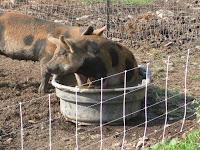 I totally understand the advent of the "pig waterer" but we obviously haven't moved in that direction. So we will continue spending 20 minutes a day cleaning out and filling the water tank as well as spraying the pigs with water (which a couple of them love) and making mud pits for them to wallow in (which all of them love). I'm hoping that in the next month or so they will put on those final 75 pounds so we can ship them off.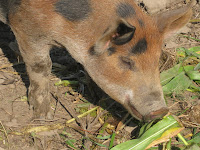

The chickens I think are feeling the heat. And they're going through a huge molting as well. Which means we are really not getting any eggs--maybe 2 a day if we're lucky. For most households, this is not necessarily a problem but the 8 year old loves, loves, LOVES french toast which requires eggs, zucchini bread uses eggs, blueberry muffins require eggs, and mayonnaise requires eggs. My darling husband is ready to dispatch the hens (this is their second year) but I'm hoping they start picking up the pace and make it through until next fall. Obviously, we will be getting a new batch of chicks in the spring to replace these current non-laying layers (keep your mind out of the gutter).
The pigs are eating us out of house and home. Each pig eats about 50lbs of grain per week in addition to any and all garden scrap, restaurant scrap, weed scrap that we have around. We also use a 50 gallon water tank for them which they prefer to stick half their bodies in when they drink, thus getting it dirty pretty quickly.
I totally understand the advent of the "pig waterer" but we obviously haven't moved in that direction. So we will continue spending 20 minutes a day cleaning out and filling the water tank as well as spraying the pigs with water (which a couple of them love) and making mud pits for them to wallow in (which all of them love). I'm hoping that in the next month or so they will put on those final 75 pounds so we can ship them off. 

Thursday, August 26, 2010
Perhaps a Good Read
I regularly peruse the New York Times online, and came across this article about Mary Catherine Bateson's (daughter of Margaret Mead) new book. It sounds like an interesting read. She has led a fascinating life for sure.
Rumors and Thistles
Mowing the lawn today, I inadvertently backed into this. 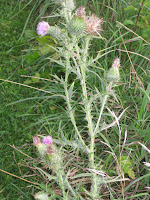
The thistle gave me quite the sting, particularly since I was wearing my old high school track pants made out of some non-breathable synthetic material akin to plastic.
I obviously recovered, and finished mowing the lawn. The thistle has a beautiful flower and from a distance, actually looks harmless. But upon closer inspection, the spiny leaves become visible and it is one plant that one does not want to cozy up to (stinging nettle, hawthorn and acacia are three others I try to avoid).
The thistle is not unlike a small town. It looks quaint and pretty from the outside, but up close, it can be quite pernicious. And the fact that it isn't so obvious (for instance, we all know not to run into cacti), makes it all the more unbearable at times.
What makes a small town pernicious? The rumor mill. Gossip and gossipers have surely been around for ages. We are all guilty of it, even if the rumors we started or propagated were not meant to harm. But there are some people who apparently thrive on being the first to know, and let others know, regardless of the accuracy of the information. The advent of social networking has exacerbated the situation. Even the mainstream media picks up on stories that are half-baked and flaunts them endlessly. The question that continually perplexes me is, "what good comes from gossiping?" What has been ingrained in us as humans, to want to even bother?
What does the rumor mill do to a small community? Essentially, it has the potential to tear it apart. When intelligent people start falling into the "he said, she did this" trap, things can escalate quickly to the point where the rumor in question contains little if any truth at all. By then, people have become so anxious and self-righteous ("I am absolutely positive that so-and-so did this!) that the rest of a close-knit community feels it needs to take sides. Overnight, it feels like lines have been drawn down the middle of the street and people carry around these biases towards institutions, individuals, ideologies etc. that are unfounded. Even when the rumor has been uncovered, the biases often remain. Just think how much collective energy could be saved and transformed into more useful ways if people just calmed down, did not jump to conclusions and basically minded their own business (or at least did some credible research before coming to conclusion). Small town living often reminds me of the old parlor game, telephone, where the original message gets skewed so poorly by the time it reaches the 10th person.
Why does this topic come up now? Twice in the last week I have heard things 3rd or 4th (or 10th?) hand that were utterly untrue and I was fascinated how such a rumor or belief could get started. I was further fascinated by the amount of angst and worry that these rumors created. If we want to live more simply, disengaging ourselves from the rumor mill (and gently encouraging others to do the same) is a wise choice.
Tuesday, August 24, 2010
Overwhelmed with vegetables
We look forward to Saturday mornings, primarily because that is when our community has its Farmers' Market. We know several of the farmers and enjoy perusing and purchasing items we don't grow such as fruit and the kohls (cabbage, broccoli), or that we don't grow enough of (peppers). We can also purchase jams, breads, cheeses, maple syrup and all sorts of other yummy homemade products. Around this time of year, however, it can all become a bit overwhelming. In the midst of of my own canning and freezing of a plethora of garden vegetables, I still went down to Main Street on Saturday with my bags in hand, ready to shop. I walked into the building, and then, reality hit. "What the heck am I doing here?! Am I crazy? Do I have time to do something with these vegetables? Do I have the motivation to do something with these vegetables?" I honestly was just about to turn on my toes and walk out when I spotted some dear friends and instead collapsed into a chair to chat. After a bit of rest, relaxation and reassessment, I determined I could buy fruit that could easily be thrown into the freezer or consumed. So I went after the peaches and blueberries. I also bought some maple syrup. I should have bought some peppers for stuffing or slicing and freezing, and more fruit for drying or freezing. After all, winter is a long season up here and it takes a lot of fruit to get us through it. But I didn't. I was just too overwhelmed. Apparently, this is not an uncommon feeling for those of us who put up a lot of food whether we grow it ourselves or purchase it through a CSA or Farmers' Market. There are just so many choices for what to purchase and what to do with it once it is purchased. And the idea that the vegetables won't wait around while you determine how you want to use them compounds the issue. I hate having to throw old veggies to the pigs (but at least they're going to the pigs and not to the compost). But I also know that much of the same types of produce will be there next Saturday. And by then, maybe I'll have psyched myself up to just do it!
Saturday, August 21, 2010
Turkey Brains

This is the second year we've raised turkeys although there was a year of no turkeys in between the two. Now, I am reminded why we took a year off in between--to allow us to forget what a crazy species this is. There is an apt reason why we ask a goofy-acting kid to stop acting like a turkey or we chastise ourselves with "turkey brains" or "bird brains" when we do something silly or forget to do something at all. Let me explain.
Our turkeys (8 Bourbon Red, 6 Royal Palm) are about 12 weeks old. Until yesterday they had been living in a rather comfortable turkey pen in the big barn. Yesterday, we decided to open the sliding door to the outside world and give them the option to fly down and out to the pasture at large. They were curious about the big outdoors but spent all day sitting on the door ledge, and staying safely inside, softly talking to themselves. Perhaps the conversation went something like this:
Gertrude: What's that bright light?
Hazel: Gee, Gertrude, I don't know? George, what is that light?
George: Um, I'm going to get more food.
Mort: We're not in Kansas anymore.
Marge: Nope, dear, this isn't Kansas. We never were in Kansas in the first place.
Mort: Is that so? Interesting. What's that down there?
Marge: I don't know. I think I'll just stay where I am.
Huxley: Oh, look, a fly. Wait, let me get it. Missed. Oh wait, there's another one.
Hazel: We're kind of far up. Okay, now, where did I leave my brain?
We relocked the door at night. Today, we repeat the pattern and as of 4pm, they had not made the leap out yet. Upon returning home around 7:30pm however, all of them were outside (probably after coming to a consensus that it was indeed okay to fly down), and huddled around the chicken yard with 2 of the birds inside the chicken yard and the remaining 12 outside (it's nice to know that at least they stick together as a group). Suddenly remembering instances from two years ago, I said out loud to my darling husband: Let me change back into my farm clothes and then we can go get them. His response, apparently not having recovered from the turkey-induced amnesia last time around was "they'll come right in when I whistle. They know that means food". After freeing the two birds that had got on the other side of the chicken fence, I went inside to change, knowing that sheparding the turkeys back in would indeed require a little bit of finesse and time. My darling husband shortly followed, coming out of his denial that the turkeys were actually intelligent creatures.
I really wished I had video taped what happened next. My darling husband is able to get the birds flocked together and headed back to the door of their pen. The problem is that it is a 4 foot flight up to that door since the barn is on a slope. The turkeys were more than a little confused not only about how they should get up there, but why bother in the first place. Now, mind you, they can fly 8 feet up to their perch at night, no problem. But having to fly up 4 feet to a 2 foot wide opening presented an unusual challenge for them...apparently. A couple of the bolder ones (I'm sure they were the hens and not the toms) took the chance, sat back on their haunches and took flight, but it was as if they were flying blindly. They'd fly up but they'd miss the doorway...repeatedly. I felt like putting a flashing neon sign above the door with a large arrow pointing "ENTER HERE!". Once the majority eventually made it back inside by random luck, the remaining birds were faster to catch on to at least attempt the flight, although watching their flockmates did nothing to improve their accuracy at flying in. We even had a couple of Royal Palms inadvertantly perform a high wire act on the electric fence (it was off) and subsequently fly into the pig pen.
Eventually, we got them all back in and tucked away for the night. As we left the pasture my darling husband says to me, "Oh come on, it was their first time having to fly up like that. They had no clue what they were doing. Remember how we looked the first time we ever tried something? Give them a break." Hmm. How many more weeks until Thanksgiving?
Our turkeys (8 Bourbon Red, 6 Royal Palm) are about 12 weeks old. Until yesterday they had been living in a rather comfortable turkey pen in the big barn. Yesterday, we decided to open the sliding door to the outside world and give them the option to fly down and out to the pasture at large. They were curious about the big outdoors but spent all day sitting on the door ledge, and staying safely inside, softly talking to themselves. Perhaps the conversation went something like this:
Gertrude: What's that bright light?
Hazel: Gee, Gertrude, I don't know? George, what is that light?
George: Um, I'm going to get more food.
Mort: We're not in Kansas anymore.
Marge: Nope, dear, this isn't Kansas. We never were in Kansas in the first place.
Mort: Is that so? Interesting. What's that down there?
Marge: I don't know. I think I'll just stay where I am.
Huxley: Oh, look, a fly. Wait, let me get it. Missed. Oh wait, there's another one.
Hazel: We're kind of far up. Okay, now, where did I leave my brain?
We relocked the door at night. Today, we repeat the pattern and as of 4pm, they had not made the leap out yet. Upon returning home around 7:30pm however, all of them were outside (probably after coming to a consensus that it was indeed okay to fly down), and huddled around the chicken yard with 2 of the birds inside the chicken yard and the remaining 12 outside (it's nice to know that at least they stick together as a group). Suddenly remembering instances from two years ago, I said out loud to my darling husband: Let me change back into my farm clothes and then we can go get them. His response, apparently not having recovered from the turkey-induced amnesia last time around was "they'll come right in when I whistle. They know that means food". After freeing the two birds that had got on the other side of the chicken fence, I went inside to change, knowing that sheparding the turkeys back in would indeed require a little bit of finesse and time. My darling husband shortly followed, coming out of his denial that the turkeys were actually intelligent creatures.
I really wished I had video taped what happened next. My darling husband is able to get the birds flocked together and headed back to the door of their pen. The problem is that it is a 4 foot flight up to that door since the barn is on a slope. The turkeys were more than a little confused not only about how they should get up there, but why bother in the first place. Now, mind you, they can fly 8 feet up to their perch at night, no problem. But having to fly up 4 feet to a 2 foot wide opening presented an unusual challenge for them...apparently. A couple of the bolder ones (I'm sure they were the hens and not the toms) took the chance, sat back on their haunches and took flight, but it was as if they were flying blindly. They'd fly up but they'd miss the doorway...repeatedly. I felt like putting a flashing neon sign above the door with a large arrow pointing "ENTER HERE!". Once the majority eventually made it back inside by random luck, the remaining birds were faster to catch on to at least attempt the flight, although watching their flockmates did nothing to improve their accuracy at flying in. We even had a couple of Royal Palms inadvertantly perform a high wire act on the electric fence (it was off) and subsequently fly into the pig pen.
Eventually, we got them all back in and tucked away for the night. As we left the pasture my darling husband says to me, "Oh come on, it was their first time having to fly up like that. They had no clue what they were doing. Remember how we looked the first time we ever tried something? Give them a break." Hmm. How many more weeks until Thanksgiving?
(The photo is actually of the last batch of turkeys. I will post new photos next week)
Friday, August 20, 2010
Alternatives to a Powerful Paradigm
Aside from our food system, there is no other area in our society more in need of reform than modern medicine. I’m not speaking of healthcare insurance reform, but the actual art and science of medicine. And at this point I realize I have just angered many, many people, perhaps some of whom think I have completely fallen off the deep end. But if this blog is about learning to live simply in a complicated world, modern medicine by its very definition, denies one the ability to live simply. And the sad realization is that it didn’t necessarily have to be that way.
The impetus to writing this post has come from my own healing experiences with and without modern medicine, as well as my observations for the past decade or so, and some academic research back in college and grad school.
If we think about it, modern (western, allopathic) medicine is basically the science of diagnosing and treating a particular ailment that affects a particular part of the body. And I do appreciate many of the "medical advances" modern medicine has "discovered" (although I think many are probably unnecessary) and I also realize that western medical professionals are compassionate human beings who primarily go into medicine to heal people. But modern medicine uses a reductionist model, isolating parts from the whole. Therefore, what it is miserably poor at doing is taking a holistic approach to the human form--the physical, emotional, mental and spiritual aspects of what it means to be human—and keeping that form well in all meanings of the word. Some may argue that modern medicine’s goal is not to treat all aspects, particularly the emotional and spiritual parts. But when an illness really encompasses all of these aspects, how "well" does a person actually become if only half of these aspects are treated?
What troubles me even more, is that with this reductionist model a treatment for one part of the body, sends another part out of whack. We see this on the popular television dramas, House and Grey's Anatomy, all the time, but it occurs every day in our own lives. All you have to do is just read the side effects on any over-the-counter or prescription drug. When treating only one specific organ system, or thinking that the trouble lies solely within one system, there is a potential to set off a cascade of events, creating more problems than were initially present. One of my favorite medical anthropology words is iatrogenic—which describes an adverse condition brought on (unintentionally) by some treatment. Using an environmental analogy, I often think that allopathic medicine is so focused on the tree, that it forgets the forest and the fragile relationship that exists between all organisms in that forest.
Enter alternative therapies. Chiropractic (interestingly, insurance companies now recognize this as a “valid” form of therapy), acupuncture, reiki, meditation, and other forms of healing. Being a rational and logical person I was very skeptical at first of all of the above. But the failure of allopathic medicine to do anything for a certain condition I have except make me feel like I was an anomaly and “not normal” led me to explore other options. My first goal was to increase the positive energy within my body. I had been feeling very negative and a friend with Parkinson’s had good experience with a reiki practitioner. He suggested one right in the Village, and I set up an appointment. My treatment ended up being both reiki and acupuncture, and eventually a series of Reconnective Healings. After about 4 months, I feel better.
I don’t pretend to understand what is really happening during reiki and acupuncture or how it occurs. What I do understand is that energy channels are being opened, areas where there is stagnation are being unblocked, and the body is becoming more balanced. I find it fascinating that the movement of energy (including thermal, auditory and visual energies) is palpable and real and (aside from acupuncture) it is done hands off. The healer and the client don’t even need to be in the same part of the country in order for Reconnective Healing to work. This has really boggled by mind, but the concept is simple. There are energy fields around us and we can learn how to manipulate those energy fields to bring our bodies back into harmony. If we are able to think of chronic disease or unwellness as any condition where the body is not in balance, where all the parts are not working harmoniously so to speak for one reason or another, then the simple solution would be to bring it back in balance. But it is impossible to try to bring one system back into balance without considering the whole body as well as external influences (I believe this is where Noetic science and the universal conscience is significant). I think I am beginning to understand that modern medicine is not necessary and perhaps not the best approach in order for re-harmonizing to occur. The film, The Living Matrix, does a beautiful job at explaining much of this in a rational way. It also justifies the power of intent, intuition and prayer.
So, why are these forms of therapy not more widespread? This was my major mental block and I asked my acupuncturist/reiki healer about it. Today, we don’t hear about it, largely because medicine is a business and big pharma is making a lot of money on our current medical paradigm. If we look at who is funding much of the medical research it is big pharma. Consequently, what gets media attention are treatments with modern medicine. So a large part of the public believes that allopathic medicine is the only obvious choice. Other alternative forms of therapy are looked upon with great skepticism. There is a societal pressure to treat illness with nothing but western medicine. But, why is that the case? I think a lot of our bias stems from the seventeenth century and the Age of Reason. Medicine suddenly fell into the category of science, based on Newtonian physics at its core (as opposed to Quantum physics, which of course, had not been “discovered” at that time). Subsequently, all illness occurring in the body had to be explained by using this model. Now, we are learning that everything occurring in the body cannot be explained by Newtonian physics, but there has not yet been a shift in paradigm. For some more in-depth reading on the subject refer to Robert L. Martensen’s “Alientation and the Production of Strangers: Western medical epistemology and the architectonics of the body. An historical perspective” published in Culture, Medicine and Psychiatry (1995) and Byron J. Good’s Medicine, Rationality and Experience: An anthropological perspective (1994).
Honestly, if I were in the position where I had some life-threatening chronic or acute disease, I don’t know if I would be brave enough to challenge modern medicine and use solely alternative therapies. I too, am held prisoner to this powerful belief system. But I have lately become so disenchanted not only by the extreme reductionist philosophy, but also with the constant trial and error that goes on when trying to diagnose and treat a condition. Because alternative therapies work by a different model, it is not necessary to pinpoint the exact origin of the problem. Energy therapies will naturally find where the problem is and support the body to make the proper manipulations. With our environment changing faster than we have adapted (thanks to our own influence), we find our bodies out of whack more than ever before (certain cancers, obesity, heart disease, infertility, depression, autism). Allopathic medicine is struggling to find a biochemical, rational reason behind each illness (usually in the form of a gene) so that a proper drug can be found to alleviate, if not cure, the illness. If more people were open to alternative therapies, and treating the whole person, not just apparently a group of cells (because it really isn't just a group of cells that is the core of the problem), not only would a lot of money and time be saved, but a lot of angst, humiliation and dehumanization in the medicalized setting could be avoided.
The impetus to writing this post has come from my own healing experiences with and without modern medicine, as well as my observations for the past decade or so, and some academic research back in college and grad school.
If we think about it, modern (western, allopathic) medicine is basically the science of diagnosing and treating a particular ailment that affects a particular part of the body. And I do appreciate many of the "medical advances" modern medicine has "discovered" (although I think many are probably unnecessary) and I also realize that western medical professionals are compassionate human beings who primarily go into medicine to heal people. But modern medicine uses a reductionist model, isolating parts from the whole. Therefore, what it is miserably poor at doing is taking a holistic approach to the human form--the physical, emotional, mental and spiritual aspects of what it means to be human—and keeping that form well in all meanings of the word. Some may argue that modern medicine’s goal is not to treat all aspects, particularly the emotional and spiritual parts. But when an illness really encompasses all of these aspects, how "well" does a person actually become if only half of these aspects are treated?
What troubles me even more, is that with this reductionist model a treatment for one part of the body, sends another part out of whack. We see this on the popular television dramas, House and Grey's Anatomy, all the time, but it occurs every day in our own lives. All you have to do is just read the side effects on any over-the-counter or prescription drug. When treating only one specific organ system, or thinking that the trouble lies solely within one system, there is a potential to set off a cascade of events, creating more problems than were initially present. One of my favorite medical anthropology words is iatrogenic—which describes an adverse condition brought on (unintentionally) by some treatment. Using an environmental analogy, I often think that allopathic medicine is so focused on the tree, that it forgets the forest and the fragile relationship that exists between all organisms in that forest.
Enter alternative therapies. Chiropractic (interestingly, insurance companies now recognize this as a “valid” form of therapy), acupuncture, reiki, meditation, and other forms of healing. Being a rational and logical person I was very skeptical at first of all of the above. But the failure of allopathic medicine to do anything for a certain condition I have except make me feel like I was an anomaly and “not normal” led me to explore other options. My first goal was to increase the positive energy within my body. I had been feeling very negative and a friend with Parkinson’s had good experience with a reiki practitioner. He suggested one right in the Village, and I set up an appointment. My treatment ended up being both reiki and acupuncture, and eventually a series of Reconnective Healings. After about 4 months, I feel better.
I don’t pretend to understand what is really happening during reiki and acupuncture or how it occurs. What I do understand is that energy channels are being opened, areas where there is stagnation are being unblocked, and the body is becoming more balanced. I find it fascinating that the movement of energy (including thermal, auditory and visual energies) is palpable and real and (aside from acupuncture) it is done hands off. The healer and the client don’t even need to be in the same part of the country in order for Reconnective Healing to work. This has really boggled by mind, but the concept is simple. There are energy fields around us and we can learn how to manipulate those energy fields to bring our bodies back into harmony. If we are able to think of chronic disease or unwellness as any condition where the body is not in balance, where all the parts are not working harmoniously so to speak for one reason or another, then the simple solution would be to bring it back in balance. But it is impossible to try to bring one system back into balance without considering the whole body as well as external influences (I believe this is where Noetic science and the universal conscience is significant). I think I am beginning to understand that modern medicine is not necessary and perhaps not the best approach in order for re-harmonizing to occur. The film, The Living Matrix, does a beautiful job at explaining much of this in a rational way. It also justifies the power of intent, intuition and prayer.
So, why are these forms of therapy not more widespread? This was my major mental block and I asked my acupuncturist/reiki healer about it. Today, we don’t hear about it, largely because medicine is a business and big pharma is making a lot of money on our current medical paradigm. If we look at who is funding much of the medical research it is big pharma. Consequently, what gets media attention are treatments with modern medicine. So a large part of the public believes that allopathic medicine is the only obvious choice. Other alternative forms of therapy are looked upon with great skepticism. There is a societal pressure to treat illness with nothing but western medicine. But, why is that the case? I think a lot of our bias stems from the seventeenth century and the Age of Reason. Medicine suddenly fell into the category of science, based on Newtonian physics at its core (as opposed to Quantum physics, which of course, had not been “discovered” at that time). Subsequently, all illness occurring in the body had to be explained by using this model. Now, we are learning that everything occurring in the body cannot be explained by Newtonian physics, but there has not yet been a shift in paradigm. For some more in-depth reading on the subject refer to Robert L. Martensen’s “Alientation and the Production of Strangers: Western medical epistemology and the architectonics of the body. An historical perspective” published in Culture, Medicine and Psychiatry (1995) and Byron J. Good’s Medicine, Rationality and Experience: An anthropological perspective (1994).
Honestly, if I were in the position where I had some life-threatening chronic or acute disease, I don’t know if I would be brave enough to challenge modern medicine and use solely alternative therapies. I too, am held prisoner to this powerful belief system. But I have lately become so disenchanted not only by the extreme reductionist philosophy, but also with the constant trial and error that goes on when trying to diagnose and treat a condition. Because alternative therapies work by a different model, it is not necessary to pinpoint the exact origin of the problem. Energy therapies will naturally find where the problem is and support the body to make the proper manipulations. With our environment changing faster than we have adapted (thanks to our own influence), we find our bodies out of whack more than ever before (certain cancers, obesity, heart disease, infertility, depression, autism). Allopathic medicine is struggling to find a biochemical, rational reason behind each illness (usually in the form of a gene) so that a proper drug can be found to alleviate, if not cure, the illness. If more people were open to alternative therapies, and treating the whole person, not just apparently a group of cells (because it really isn't just a group of cells that is the core of the problem), not only would a lot of money and time be saved, but a lot of angst, humiliation and dehumanization in the medicalized setting could be avoided.
Thursday, August 19, 2010
Miscellany
I'm working on a relatively in depth post that I'm sure will stimulate some comments so here are a few updates to enjoy in the meantime.
Really, it's been a crazy couple of days. The five cords of wood are finally stacked. I know that for "real" farmers, that is probably a pitiful amount, but we had never had more than a couple of face cords to stack at one time. My darling husband's most memorable comment while stacking in the dark, dank basement (aside from "there's a lot of wood") was: "Something large and furry definitely just crawled over my feet." I have been conducting interviews for teaching positions, which is pulling me away from the farm, and particularly the garden. I did end up staking all of the tomato plants (which I had failed to do earlier) and they are in the process of ripening. The one problem with doing this is that tomato plants stain really easily. So, the first morning of interviews, I was in the shower and noticed how dirty my hands looked (even though they were quite clean--just stained brown). Well, that's country life I suppose. I suspect our candidates were too nervous to really notice. We also had to pull the potatoes out due to something getting to them. They are still really "new potatoes" and I wonder if they will end up storing okay. Not nearly as many as last year which is unfortunate as those tend to be a staple of winter dining. Speaking of food, a couple people made me aware of this link from the New York Times about local eating in the Berkshires.
Just as the evening was winding down, the neighbor's heifer apparently got bored and figured out how to get out of her pasture and into our yard. She ended up in one of our open pastures (which we closed when she got in it), met the horse, and then started bawling (in the way only cows can do) for her own pasture-mates. We phoned our neighbors up, and they got the heifer safely over to her pasture (and actually then moved all the bovines to their far pasture so they couldn't break through again) and came over to chat. Apparently, their neighbor's on the other side (renters) have a couple of dogs that ate half their chickens the other day. Yikes! Not good. Right now, our fence charger which is normally on the chicken fence is on the corn (to prevent raccoons from eating it). If we didn't have our own dogs who are relatively good watch dogs, I would probably electrify the chicken fence again. I guess the question is whether eggs are more valuable than a few bushels of corn...
Really, it's been a crazy couple of days. The five cords of wood are finally stacked. I know that for "real" farmers, that is probably a pitiful amount, but we had never had more than a couple of face cords to stack at one time. My darling husband's most memorable comment while stacking in the dark, dank basement (aside from "there's a lot of wood") was: "Something large and furry definitely just crawled over my feet." I have been conducting interviews for teaching positions, which is pulling me away from the farm, and particularly the garden. I did end up staking all of the tomato plants (which I had failed to do earlier) and they are in the process of ripening. The one problem with doing this is that tomato plants stain really easily. So, the first morning of interviews, I was in the shower and noticed how dirty my hands looked (even though they were quite clean--just stained brown). Well, that's country life I suppose. I suspect our candidates were too nervous to really notice. We also had to pull the potatoes out due to something getting to them. They are still really "new potatoes" and I wonder if they will end up storing okay. Not nearly as many as last year which is unfortunate as those tend to be a staple of winter dining. Speaking of food, a couple people made me aware of this link from the New York Times about local eating in the Berkshires.
Just as the evening was winding down, the neighbor's heifer apparently got bored and figured out how to get out of her pasture and into our yard. She ended up in one of our open pastures (which we closed when she got in it), met the horse, and then started bawling (in the way only cows can do) for her own pasture-mates. We phoned our neighbors up, and they got the heifer safely over to her pasture (and actually then moved all the bovines to their far pasture so they couldn't break through again) and came over to chat. Apparently, their neighbor's on the other side (renters) have a couple of dogs that ate half their chickens the other day. Yikes! Not good. Right now, our fence charger which is normally on the chicken fence is on the corn (to prevent raccoons from eating it). If we didn't have our own dogs who are relatively good watch dogs, I would probably electrify the chicken fence again. I guess the question is whether eggs are more valuable than a few bushels of corn...
Monday, August 16, 2010
The Dynamic Duo
The kittens had to go to the vet today for some boosters and a rabies vaccination. They are 14 weeks old and anxious to roam about more. Right now, they have free range of the little barn, but they are outgrowing these boundaries. Unfortunately, I can't let them out until 3 weeks after their rabies vaccination. And I also want to get the female spayed. The male will get neutered, but we have to wait until he's 6 months. Anyway, these kittens certainly know when they are on display. Everybody thought they were really cute at the vet and were enjoying the feline company. The kittens were having a good time too, until they got two shots each.
She saw me with the camera, and immediately sat down. Not the best facial expression, but at least she was still for the photo.
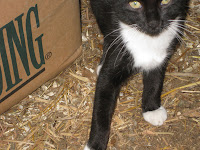

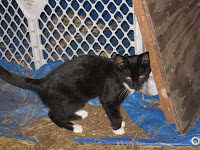
Upon paying for the vaccinations I was told that they needed names to go on their rabies certificates. At home we had been tossing out names casually for some weeks. They were originally R2 and D2. R2 soon became Romeo for his loving nature, but naming his sister Juliet just wasn't okay. Plus they both had tragic endings. One has a white ring around its neck, so Ringo was suggested. Unfortunately, that kitten was the female. Yoko Ono and Lennon? Also tragic and not good for a brother and sister. So, what famous brother-sister pair is there? The first and really only one I could think of that didn't end tragically is Luke Skywalker and Princess Leia. And so in that moment at the reception desk at the vet, the kittens were christened Luke and Leia. And no, I'm not sure how to spell Leia, but that's the spelling that's going to appear on the rabies certificate.
Now Leia is really not a "princess" princess if you know what I mean. She's relatively laid back and minds her own business. Yes, she's affectionate, enjoys being held, and purrs all the time, but doesn't have that particular air around her. Not demanding or condescending or a beauty queen. Of course, I don't think Princess Leia played by Carrie Fisher had that "princess" quality either. She was pretty hardcore. But to Leia's credit, the cat does know how to pose.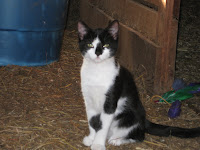
She saw me with the camera, and immediately sat down. Not the best facial expression, but at least she was still for the photo.
Getting her brother to stay still for a shot was a different story. The following are the pictures that I got of him, none of which captures his true self (or maybe they do?!):


This is where I would normally insert some off-color remark about males in general, but I will refrain. I can tell yout this: after seeing the bill for the vaccinations, Luke and Leia are going to have to start earning their keep with some serious mousing!
Saturday, August 14, 2010
Cucumbers, cucumbers everywhere
I really cannot keep up with the cucumbers. They just keep growing, and growing. I don't know how many jars of pickles I can actually make. The last few days have been very busy on the farm. After a lull in July, August is a big month for getting ready for winter. Our four cords (not face cords) of wood are being trucked in and we are spending lots of time moving and stacking logs. Not a whole lot of fun. We also moved our sheep for the last time up to the big hill. They will graze that down, and then over the course of the next two or three months we will slowly move their pasture back towards the barn. But the largest consumption of time is the food processing. Now that so much is ready for harvesting, I am spending entire days in the kitchen preparing it. I am also aware of the produce we don't grow on our farm and buying that now as well to put up for the winter. I bought peaches, blueberries and strawberries at the farmer's market, and have frozen all of the above so we will have fruit in the off season. I've also probably bought a 1/2 bushel of peppers to slice up, saute and freeze, or stuff. We always try to grow our own bell peppers, but we rarely get a lot. I have also frozen several quarts of corn. Our own corn from the garden isn't ready yet so I buy a dozen or so ears at a time from various roadside stands. The celery is also in on various farms. We don't really eat celery but we do make lots of soup during the winter, so I chopped that up as well to freeze. I made a mint and zucchini fritatta yesterday to use up eggs, mint and zucchini; all things that we have in (over)abundance on the farm. I also have made zucchini bread, zucchini relish, stuffed zucchini, and I plan on making zucchini and feta pancakes. Lots of zucchini. Luckily, it can just be grated and thrown in the freezer for future use. We are also fortunate to have 6 hogs who will happily chow down on the squash that gets too large. Something is getting into the carrots and gnawing at the tops. I'm not sure how well they will store, so I plan on making a beet and carrot salad, and maybe canning the carrots instead of storing them in the root cellar. Carrot cake is always a possibility too!
Saturday, August 7, 2010
Finding Grace
Living life gracefully. Not so much happening here in Upstate, but I'm trying. Somtimes I see fleeting glimpses of grace. I'm trying to let the little things go, to live in the moment, in harmony with nature's time and not by our own ridiculously contrived timepieces.
A good example of where I almost lost my cool occurred last week. We have a quaint, extremely convenient and defininitely overpriced general store in our village center (2 miles from our farm). I "had" to get gas for both the car and the lawnmower as well as pick up a gallon of milk for breakfast. I think I forgot, or otherwise pretended not to notice, that it was a Friday morning, and thus "changeover" day for the tourists. But they couldn't really be invading our quiet little hamlet, right? I said right?!? Wrong. There clearly was no easy parking in front of the store, around the gas station pumps or on the side of the road. I maneuvered my way to the far left of the store and sidled the car in to a space. Purchasing the milk was no problem. Purchasing the gas was. Both sides of the pump were busy. Fine. No problem. As soon as the pick-up left Pump 1, I turned on the car, and was approaching the pump when a hugely oversized, out-of-state (I won't mention what state so as not to offend relatives) SUV did a veritable J-turn and backed right in (rather gracefully, I must add, for such a behomoth). That's when I took a deep breath. Okay. He probably didn't see me. I could have laid on the horn, but really, that wouldn't have accomplished much. So I continued to sit there. The pick-up at the other pump was without owner; presumably she was inside paying. So I waited. I contemplated whether I really "needed" the gas. I'm sure the lawn wouldn't have minded going another four days without mowing, but I was confident that the grass would soon follow into the natural ecological succession of things, and become "meadow", "shrubland" and then finally "deciduous forest".
So I waited some more. The owner doesn't return to her pick-up. Vehicles continue to manuever in and out of the parking area (I hesitate to call it a lot), and business is obviously booming at the store this morning. The SUV finally finishes gassing up at his spot, and I (with very little grace), get to the pump at last. Meanwhile, pick-up is still without owner, and there are definitely more people waiting for gas. Even if there was a line at the cash register, it wouldn't have taken her this long to pay. Then I notice something out of the corner of my eye. It is the pick-up's owner, and she is chatting with someone at the entrance to the store, cup of coffee in one hand, keys in the other. This is when I am about to blow a gasket. I come very close to saying something, but I don't. As I finish filling my tank and the gas container, she is still chatting away. I drive away, and no sonner have I left the pump, then another individual swoops into my place.
It is true, that I was not in a hurry that day (and neither was the woman with the pick-up apparently). But I was anxious for all those who were. In both the case of the SUV and pick-up, my first reaction was that I couldn't believe how inconsiderate and/or completely oblivious some people can act. But then I reminded myself, that we have all acted in such ways before, and probably will again. Perhaps the incident taught me to be a little bit more flexible, and a little bit more patient. In the long story of life, does it really matter that it took me 15 minutes in our little hamlet to get gas at the general store? No. On the other hand, something truly meaningful or profound may have occurred in the conversation between the pick-up woman and her friend. I don't know, and therefore, I cannot judge; I will simply try to continue to live gracefully.
Monday, August 2, 2010
The Vegetable Patch
Returning from vacation, I went up to our garden to see what had transpired over the previous ten days. The good news was that the bush beans were abundant. I have already frozen 8 quarts and I suspect I will get another 5-6 before the season ends. A favorite green bean dish that we use with the frozen beans is simply to saute them with some pine nuts (or almonds) in olive oil and a little butter; add some fresh nutmeg, pepper and salt and voila. Done. Also in the good news category is that I have squash this year! Last year, with the cold, damp weather, none of my squash (winter, cucumbers, summer) materialized. So now I am left with the dilemma of what to do with the oodles of zucchini. I have already stuffed some and made some into bread. I will probably end up pickling some when I pickle the cukes later on. And then I will shred and freeze the remainder for use in bread and casseroles during the winter.
The bad news is that we had a torrential rain storm after several days of hot, dry weather. This meant that much of the second planting of peas and the third planting of lettuce essentially got washed away. Bummer.
Also, the potatoes and tomatoes look questionable. After a horrible late blight season last year, I am somewhat paranoid. I brought samples of each to our Cooperative Extension and they were unable to determine if blight was present. Apparently, the leaves are in really good condition, but the black lesion on the stem (and that plant was the only one with the black lesion) concerned her as it did me. Her advice was just to keep a close eye on the situation. So far I have and everything is stable. We'll just have to wait and see.
Wednesday, July 28, 2010
A Garden Make-Over
We have a well-established flower bed at the head of the driveway, and last fall we decided we were going to make it into a large horseshoe shape surrounding the fire pit; essentially tripleing the size of the existing garden. We (rather, my darling husband) rotatilled the area, but then left it pretty much alone until the spring. After adding piles of sheep manure on it, and still leaving it alone, the weeds took over. I also didn't do anything with the established bed, so the weeds took over there crowding out the perennials. 
Yes, that is the garden right there. You can see the lamb's ears but not much else. Granted, there wasn't much of anything blooming earlier in the spring, but clearly it has been overtaken by the not-so-desirables. My dearest mother commented around this time that perhaps we shouldn't expand the garden until we get what we have under control.
So, several weeks ago, my husband got sick of just looking at the dirt and weeds, and he made one end of the horseshoe into a herb garden. While there are several annual herbs in there (parsley, basil), most of it consists of hardier herbs (lemon balm, sage, rosmary, lavendar, stevia).

Now that one quarter of the garden was dealt with, it looked silly leaving the rest of the horseshoe as dirt. So, I finally decided to dig in after our vacation south, and for three days I weeded, separated, transplanted and mulched. I went to the local garden nursery and bought several perennials (russian sage, false indigo, black eyed susans, astilbe, sedum) and then separated out some of the goosenecks, daisies, phlox, and lamb's ears from the established garden. The pictures below are the finished product working from the established garden to the left around the horseshoe.


 It will obviously take a couple years for the garden to mature into something resembling a beautiful garden. The Russian sage is a huge space filler and is rather pretty as well. We'll see what happens in the coming months and years. It is, however, a start.
Saturday, July 24, 2010
A Thousand Islands Break

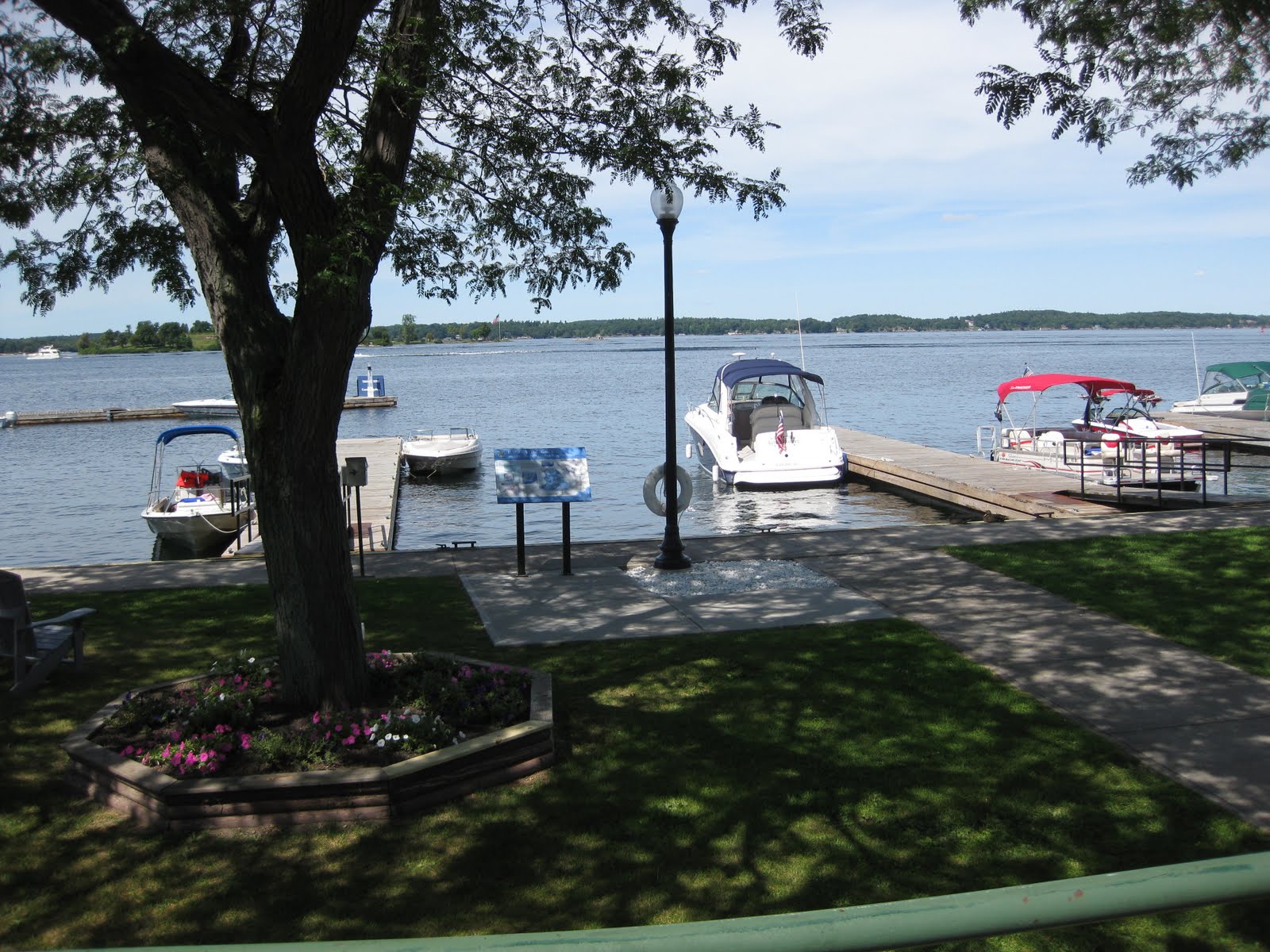
It is difficult to describe with words the spectacular beauty of the Thousand Islands. Over 1800 islands spot a 50 mile stretch of the St. Lawrence river, creating a unique culture of water and land, unhindered by international boundaries (the US and Canada). For a wonderful read about the feel of the region, turn to John Keats' (not the poet) Of Time and an Island and for some beautiful more recent  photography see Ian Coristine's books.
My husband and I decided to take off for a long weekend in July. We stayed in Cape Vincent, on the US mainland, but traveled by ferry, bicycle, bridge and boat to neighboring islands. Cape Vincent is a quiet, quaint village for 362 days of the year. However, we had planned our trip to coincide with its annual French Festival. As legend has it, Napoleon's (yes, the Napoleon) brother had bought some land in the region for Napoleon and his family to escape to after his defeat at Waterloo. As often happens, even the best laid plans can fail to materialize, and Napoleon never made it the 1000 Islands. But the town still celebrates with a large parade, French pastries, lots of music, vendors, and an inordinate amount of alcohol.
We were staying at a lovely motel/B&B right on the water, and each morning while there we would grab a coffee and the most delicious croissants and then go sit on the bench over the river watching the ships. Cape Vincent sits at the point where Lake Ontario becomes the St. Lawrence river so any international ship legally has to pick up a local captain here to pilot the ship through the Seaway as it is incredibly difficult to navigate through the shoals and the 1800+ islands. We enjoyed watching a pilot boat take a captain out to the cargo ship and see him climb aboard.
The ferry to Canada leaves Cape Vincent to go to the nearest island (Wolfe Island, Canada) allegedly every hour on the quarter hour but as we figured out, the schedule was just a guide. We took our bikes over and after going through customs, we rode to a protected sandy bay area with the most gorgeous beach. Ten miles of biking on gravel though was not the most comfortable experience however.
On Sunday, we went to a church service at Half Moon Bay (also Canada). The unique aspect of this service was that it is only accessible by boat, and people stayed in their boat (or jet ski) for the service. After service, we went over to a friend's island for dinner. She happens to be the editor for Thousands Islands Life. My husband had contacted her a while back regarding his most recent novel, and she just invited us to come over for dinner when we were in the area. It turns out that she holds dinner parties every weekend during the summer and she has the wonderful ability of bringing together a group of friends, strangers, colleagues and acquaintances, all sharing common interests and vocations, thus creating a lively evening for all.
It was a wonderful and relaxing weekend where neither of us looked at our watches. The concept of time is very different for folks in the region. Very few Islanders actually stay year round, but they don't really have a set date for leaving or arriving. Many just arrive when the ice on the river starts to break up and don't leave again until the ice starts to form. If it's an early spring, great. If not, that's okay too. Furthermore, as demonstrated at our dinner party, since many do not want to be boating on the river after dark, the party is over as the sun sets, regardless of the clock time. Clock time is not important to the Islanders; they leave such things up to Mother Nature. If only we all could follow their example a little more often and not always be hindered by the clock.
 photography see Ian Coristine's books.
My husband and I decided to take off for a long weekend in July. We stayed in Cape Vincent, on the US mainland, but traveled by ferry, bicycle, bridge and boat to neighboring islands. Cape Vincent is a quiet, quaint village for 362 days of the year. However, we had planned our trip to coincide with its annual French Festival. As legend has it, Napoleon's (yes, the Napoleon) brother had bought some land in the region for Napoleon and his family to escape to after his defeat at Waterloo. As often happens, even the best laid plans can fail to materialize, and Napoleon never made it the 1000 Islands. But the town still celebrates with a large parade, French pastries, lots of music, vendors, and an inordinate amount of alcohol.
We were staying at a lovely motel/B&B right on the water, and each morning while there we would grab a coffee and the most delicious croissants and then go sit on the bench over the river watching the ships. Cape Vincent sits at the point where Lake Ontario becomes the St. Lawrence river so any international ship legally has to pick up a local captain here to pilot the ship through the Seaway as it is incredibly difficult to navigate through the shoals and the 1800+ islands. We enjoyed watching a pilot boat take a captain out to the cargo ship and see him climb aboard.
The ferry to Canada leaves Cape Vincent to go to the nearest island (Wolfe Island, Canada) allegedly every hour on the quarter hour but as we figured out, the schedule was just a guide. We took our bikes over and after going through customs, we rode to a protected sandy bay area with the most gorgeous beach. Ten miles of biking on gravel though was not the most comfortable experience however.
On Sunday, we went to a church service at Half Moon Bay (also Canada). The unique aspect of this service was that it is only accessible by boat, and people stayed in their boat (or jet ski) for the service. After service, we went over to a friend's island for dinner. She happens to be the editor for Thousands Islands Life. My husband had contacted her a while back regarding his most recent novel, and she just invited us to come over for dinner when we were in the area. It turns out that she holds dinner parties every weekend during the summer and she has the wonderful ability of bringing together a group of friends, strangers, colleagues and acquaintances, all sharing common interests and vocations, thus creating a lively evening for all.
It was a wonderful and relaxing weekend where neither of us looked at our watches. The concept of time is very different for folks in the region. Very few Islanders actually stay year round, but they don't really have a set date for leaving or arriving. Many just arrive when the ice on the river starts to break up and don't leave again until the ice starts to form. If it's an early spring, great. If not, that's okay too. Furthermore, as demonstrated at our dinner party, since many do not want to be boating on the river after dark, the party is over as the sun sets, regardless of the clock time. Clock time is not important to the Islanders; they leave such things up to Mother Nature. If only we all could follow their example a little more often and not always be hindered by the clock.
Tuesday, July 13, 2010
Thoughts on Tourism
My darling husband and I were able to escape for a few days up to the Thousand Island region on the St. Lawrence river. We enjoyed beautiful weather, fine food, excellent bicycling, kayaking and good entertainment as well. Coming from a touristy area ourselves, we were very aware of how the locals could potentially view us. Tourists, by definition, do not have to be annoying and a harmonious relationship can exist between the two entities. Afterall, tourism is an industry, and if done right, can benefit the community.
I make it a point to shop locally, but I am particularly aware of this when vacationing. The locals (beyond the employees) do not really benefit if I shop or eat at one of the chain stores. The executives of these chains take the money and throw it somewhere else. If I choose to shop at local boutiques, then I know the local shopowners are going to use their income locally and thus create a positive feedback cycle.
Unfortunately, in our area, the main attraction (at least for the teenagers) is owned by people who live several states away. They have developed this complex so much, the families don't even need to come into town anymore to eat, or shop. In addition, so much of the housing is rented out on a weekly basis during the summer that there is no year-round rental market anymore. I have removed myself somewhat from the politics of all of this, but basically, the lack of affordable housing (rentals) has contributed to the lowering enrollment of the school district, which in turn has resulted in numerous budget cuts and loss of services at the school. This isn't the fault of the tourists themselves; it's a lack of forethought and a general attitude of greed (or is it the tug of capitalism?). Bigger is better! Expansion is great! Let's cater to the tourists! Nothing better than cash in the pocket! I think, however, that our stores have forgotten the local population and the long term effects of such behavior. I am grateful for the few restaurants in town that don't particularly cater to the tourists (groups of teenagers accompanied by adults). I talk to old-timers and they describe what Main St. used to look like with its hardware stores, drug stores, clothing shops etc. My biggest worry is that when the main attraction for the teenagers shuts down, will there be anything left to sustain the local population? So many of our local storefronts have been transformed into souvenir shops that I fear that we will become another ghost town of Upstate New York if the tourists were to leave. We can't just go back to the "days before" where there were just the Museums and not much else that sent New Yorkers and Bostonians flocking here. I believe our community has gotten itself caught up in a vicious circle, where now it has no choice to keep up with the frazzled pace, unless it wants to lose everything.
I make it a point to shop locally, but I am particularly aware of this when vacationing. The locals (beyond the employees) do not really benefit if I shop or eat at one of the chain stores. The executives of these chains take the money and throw it somewhere else. If I choose to shop at local boutiques, then I know the local shopowners are going to use their income locally and thus create a positive feedback cycle.
Unfortunately, in our area, the main attraction (at least for the teenagers) is owned by people who live several states away. They have developed this complex so much, the families don't even need to come into town anymore to eat, or shop. In addition, so much of the housing is rented out on a weekly basis during the summer that there is no year-round rental market anymore. I have removed myself somewhat from the politics of all of this, but basically, the lack of affordable housing (rentals) has contributed to the lowering enrollment of the school district, which in turn has resulted in numerous budget cuts and loss of services at the school. This isn't the fault of the tourists themselves; it's a lack of forethought and a general attitude of greed (or is it the tug of capitalism?). Bigger is better! Expansion is great! Let's cater to the tourists! Nothing better than cash in the pocket! I think, however, that our stores have forgotten the local population and the long term effects of such behavior. I am grateful for the few restaurants in town that don't particularly cater to the tourists (groups of teenagers accompanied by adults). I talk to old-timers and they describe what Main St. used to look like with its hardware stores, drug stores, clothing shops etc. My biggest worry is that when the main attraction for the teenagers shuts down, will there be anything left to sustain the local population? So many of our local storefronts have been transformed into souvenir shops that I fear that we will become another ghost town of Upstate New York if the tourists were to leave. We can't just go back to the "days before" where there were just the Museums and not much else that sent New Yorkers and Bostonians flocking here. I believe our community has gotten itself caught up in a vicious circle, where now it has no choice to keep up with the frazzled pace, unless it wants to lose everything.
Monday, July 5, 2010
Dog Days of Summer
It's hot out today. Sweat dripping down your back in the shade hot. Not unusual for some parts of the country, and I for one am a big fan of such weather. Daisy, our two year old lab whom we acquired last fall, is definitely not a dog that enjoys heat. Within two seconds of being outside, she is panting up a storm and wanting to be back inside (unless of course, we are outside and food is involved). On the other hand (paw?), Belle, our 8 year old mutt of hound origins, who has never been very people oriented, will stay outside in the blistering heat all day if she could. She lumbers from sun to shade and back to sun, blissfully ingorant of everything around her. Yesterday evening the chickens were pecking their way through the yard and came upon her, and she couldn't care less.
The horse is not happy about the heat or the flies. He spends his days under the apple tree, tail switching constantly. He has exhibited some interesting behavior the last few days. Around 5pm the other day, he started galloping around. Up the hill and down. Back and forth. He paused for a few seconds, then continued on his sprint to nowhere. In minutes he had worked up a good lather. This evening run has continued for the past few days. Although initially concerned, I believe he is just letting loose some of the stored up energy since he is spending all day under the apple tree and not grazing throughout the day as he would do in more temperate weather. Perhaps it's also because I called him fat to his face (which he is since he has been gorging himself on grass all spring).
The vegetables, aside from the tomatoes and peppers, are not fans of the heat either. While in cooler weather the peas could keep going for another couple of weeks, the dramatic turn from green to yellow overnight is a clear sign to me that they have decided they are through. Done. End of story. And this despite a thorough drenching with the sprinkler last night. I still have time for a second planting if I put the seeds in the ground sometime next week.
So we continue on at the farm. The dog days of summer are here, perhaps for a while.
The horse is not happy about the heat or the flies. He spends his days under the apple tree, tail switching constantly. He has exhibited some interesting behavior the last few days. Around 5pm the other day, he started galloping around. Up the hill and down. Back and forth. He paused for a few seconds, then continued on his sprint to nowhere. In minutes he had worked up a good lather. This evening run has continued for the past few days. Although initially concerned, I believe he is just letting loose some of the stored up energy since he is spending all day under the apple tree and not grazing throughout the day as he would do in more temperate weather. Perhaps it's also because I called him fat to his face (which he is since he has been gorging himself on grass all spring).
The vegetables, aside from the tomatoes and peppers, are not fans of the heat either. While in cooler weather the peas could keep going for another couple of weeks, the dramatic turn from green to yellow overnight is a clear sign to me that they have decided they are through. Done. End of story. And this despite a thorough drenching with the sprinkler last night. I still have time for a second planting if I put the seeds in the ground sometime next week.
So we continue on at the farm. The dog days of summer are here, perhaps for a while.
Thursday, July 1, 2010
Circles in the Lawn
Odd, yes. But I find a certain quiet solitude every time I mow the lawn. We do own a push mower (and it does run on gasoline) and it takes me about two hours to mow the entire lawn. The drone of the mower blocks out any excess noise (barking dogs, whiny children etc), and I'm only left with my thoughts and some physical activity.
I suppose the phenomenon is similar to that of running, hiking, swimming or bicycling, although with mowing I actually get to check a chore off of the list. The activity is solitary, yet relatively monotonous. I find such activity particularly useful after a stressful day or event when I need to vent some frustration. Inevitably, I am much calmer at the end of the task, if only from exhaustion.
The back lawn grows about twice as fast ast the front, and its thick lush grass lends itself to lots of yard games, a cozy place to nap, and frequently clogging up the lawn mower. Thus, I have remembered to only make half paths as I mow that section. To mix it up, I find myself mowing in variouos patterns. Do I go horizontal, vertical, curvy, criss cross or circular today? Perhaps the choice of pattern says something about my frame of mind at the time. Straight lines are very purposeful. If I get to the point of mowing in ever smaller circles, it's because I'm in a more whimsical mood. I have even been known to make criss-cross patterns, not unlike celtic designs, in order to entertain a 7 year old who trailed behind in the freshly mowed paths. Regardless, the lawn eventually gets mowed, and looks great for about 3 days before it is beckoning to be mowed again.
A couple of lawn care tips from the farm: In order to keep our lawn healthy, we don't use any chemical fertilizers or pesticides. We also mow only down to four inches, which keeps the grass from turning brown.
I suppose the phenomenon is similar to that of running, hiking, swimming or bicycling, although with mowing I actually get to check a chore off of the list. The activity is solitary, yet relatively monotonous. I find such activity particularly useful after a stressful day or event when I need to vent some frustration. Inevitably, I am much calmer at the end of the task, if only from exhaustion.
The back lawn grows about twice as fast ast the front, and its thick lush grass lends itself to lots of yard games, a cozy place to nap, and frequently clogging up the lawn mower. Thus, I have remembered to only make half paths as I mow that section. To mix it up, I find myself mowing in variouos patterns. Do I go horizontal, vertical, curvy, criss cross or circular today? Perhaps the choice of pattern says something about my frame of mind at the time. Straight lines are very purposeful. If I get to the point of mowing in ever smaller circles, it's because I'm in a more whimsical mood. I have even been known to make criss-cross patterns, not unlike celtic designs, in order to entertain a 7 year old who trailed behind in the freshly mowed paths. Regardless, the lawn eventually gets mowed, and looks great for about 3 days before it is beckoning to be mowed again.
A couple of lawn care tips from the farm: In order to keep our lawn healthy, we don't use any chemical fertilizers or pesticides. We also mow only down to four inches, which keeps the grass from turning brown.
Subscribe to:
Posts (Atom)